
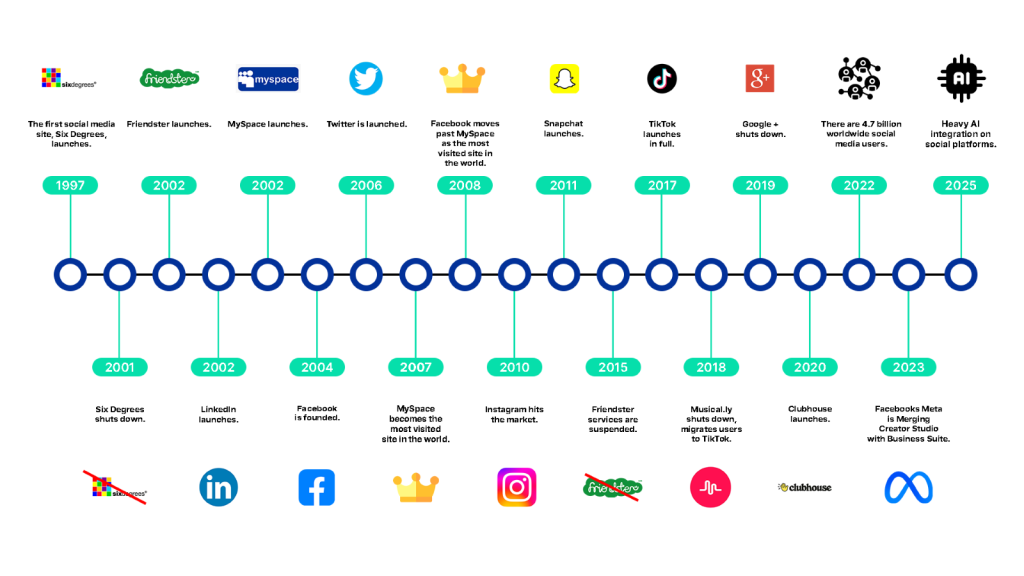
It seems like social media has always been part of daily life. But the modern history of social media is only a few decades old, and most of the platforms we use today are even younger. This guide covers what social media is, how it evolved, and a timeline of major platforms from early sites like SixDegrees and MySpace to today’s short-form video era, including TikTok, Reels, and Shorts.
Key Takeaways: The History of Social Media
- Social media began in the late 1990s, when SixDegrees launched in 1997 with user profiles and friend lists. Wikipedia
- Today, more than 5 billion people worldwide use social media, making it one of the fastest-adopted technologies in human history. DataReportal
- The history of social media fits into a few eras: early social networks (SixDegrees, Friendster, MySpace), the mobile and visual era (Facebook, Instagram, Snapchat), and the short-form video and AI era (TikTok, Reels, Shorts, Threads).
What Is Social Media?
Social media refers to online platforms where people create profiles, share content, and connect with others in real time. The core idea is simple: you post something, and other people can respond, react, and share it. Most social platforms combine three key ingredients: user-generated content, a social graph (friends, followers, connections), and interactive tools like comments, likes, shares, and direct messages.
How Do We Define Social Media Today?
Before the apps we know now, there were plenty of “social” ways to communicate, both offline and online. Town bulletin boards, email lists, chat rooms, and forums all helped people gather around shared interests.
But social media in the 2020s looks different. The evolution of social media has shifted from simple chronological updates to algorithmic feeds, personalized recommendations, short-form video, and messaging that is baked into almost every platform. If you’re looking at a social media history timeline, this is a major turning point: discovery is now driven as much by AI and ranking systems as it is by who you follow.
Did Mark Zuckerberg Invent Social Media?
No, Mark Zuckerberg did not invent social media. Facebook is a huge chapter in social media history, but its roots go back to 1990s online communities and early social networking sites like SixDegrees. To see where Facebook fits in, it helps to look at a social media timeline that starts with the earliest platforms, before “social media” was even a common phrase.
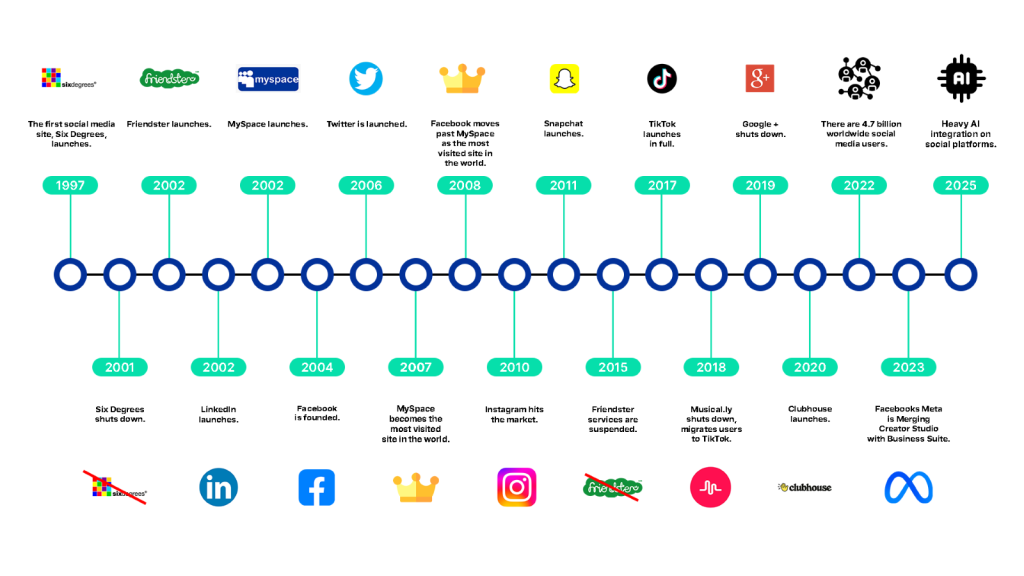
Social Media Timeline: From SixDegrees to TikTok and Threads
Social media didn’t appear overnight. It evolved in waves, with each wave shaped by new technology, new habits, and new ways to share content.
Before Social Media: Bulletin Boards, Forums, and Early Online Communities
Online communities originate from the earliest days of the internet. Bulletin Board Systems (BBS), Usenet, early forums, AOL communities, and Yahoo Groups gave users a way to post messages, join discussions, and build connections around shared topics long before the advent of social media. They were important steppingstones, but they didn't have the same structure that defines social media platforms today.
BBS, Usenet, Forums, AOL, Yahoo Groups
| Year (Approx.) | Platform | Key Feature / Innovation | Approx. Users (Peak or Current) | Status |
|---|---|---|---|---|
| 1978+ | BBS | Local dial-up community boards, messages, file sharing | N/A (varied by system) | Mostly sunset; niche hobbyist use |
| 1980+ | Usenet | Distributed discussion groups (“newsgroups”) | N/A | Still exists in limited form |
| 1990s | Web Forums | Topic-based communities with threads and moderation | N/A | Many still active |
| 1985+ | AOL Communities | Mainstream consumer access to chat and groups | N/A | AOL rebranded; communities largely changed |
| 2001+ | Yahoo Groups | Email lists plus group pages, files, threads | N/A | Shut down (service sunset in 2020) |
The First Wave of Social Networks (1997–2005)
This era is the answer to a common question: When did social media start? Profiles and friend lists became the foundation during this era where the first signs of modern social media began to take shape.
SixDegrees introduced a recognizable pattern: make a profile, list your friends, and expand outward. Friendster scaled that concept quickly, then ran into technical and business challenges. MySpace made social networking cultural, especially through music and highly customizable profiles. LinkedIn took a different route by focusing on professional identity and career connections.
SixDegrees, Friendster, MySpace, LinkedIn
| Year | Platform | Key Feature / Innovation | Approx. Users (Peak or Current) | Status |
|---|---|---|---|---|
| 1997 | SixDegrees | Profiles + friend lists, early “degrees of connection” | 3.5M registered users (reported peak) | Defunct |
| 2002 | Friendster | Early “real identity” network effects, social discovery | 115M+ registered users (reported milestone) | Defunct (sunset) |
| 2003 | MySpace | Custom profiles, music discovery, culture-first social | 50M visitors (May 2006); 114M+ global visitors (June 2007, comScore) | Still exists, niche |
| 2003 | Professional networking, resumes, hiring | 1B+ members (reported) | Active |
The Web 2.0 Era (2004–2010): Feeds and User-Generated Content
The dynamic evolution of the internet Web 2.0 ushered in modernized social media. Feeds became the norm, sharing got easier, and platforms thrived on user-generated content.
Facebook’s impact defined social media as we know it and went from a college experiment to a social networking norm. YouTube popularized video sharing on a global scale, while the breadth of the video content made YouTube one of the most popular search engines. Twitter’s real-time posting and conversational nature became part of users, daily (or hourly) news updates.
Facebook, YouTube, Twitter/X
| Year | Platform | Key Feature / Innovation | Approx. Users (Peak or Current) | Status |
|---|---|---|---|---|
| 2004 | Feed-driven social network; massive scale | Meta reports 3.54B Family Daily Active People (Oct 2025) | Active | |
| 2005 | YouTube | Easy video uploads, channels, viral distribution | Billions of monthly logged-in users (as of Apr 2025) | Active |
| 2006 | Twitter/X | Micro-posting, trending topics, public conversation | 570M monthly users worldwide (July 2024, X) | Active (rebranded) |
The Mobile & Visual Era (2010–2016)
With the introduction of smartphones, social media became ever-present. It became always-on, camera-first, and based on quick hits of content instead of long posts you’d write at a desktop computer.
Instagram helped normalize visual sharing as a daily habit. Snapchat reshaped messaging by making content feel more casual and temporary, and it introduced features like Stories and AR lenses that many platforms later copied.
Instagram, Snapchat
| Year | Platform | Key Feature / Innovation | Approx. Users (Peak or Current) | Status |
|---|---|---|---|---|
| 2010 | Photo-first social with filters; later Stories and Reels | 3B MAU (Sept 2025, Reuters) | Active | |
| 2011 | Snapchat | Disappearing messages, Stories, AR lenses | 477M DAU; 943M MAU (Q3 2025, Snap Inc. Investors) | Active |
Short-Form Video and the Super-App Era (2016–Present)
This is the biggest social media format shift since the feed. Social media moved from “posts” to continuous video streams, with algorithms that can make a creator’s reach go viral overnight. TikTok popularized the “For You”-style discovery feed and made vertical short-form video the default. Instagram Reels and YouTube Shorts followed quickly, and Stories became a standard feature across multiple platforms. Threads entered the mix as a conversation-first platform, positioned as a modern alternative to Twitter/X.
TikTok, Instagram Reels, YouTube Shorts, Facebook Stories, Threads
| Year | Platform | Key Feature / Innovation | Approx. Users (Peak or Current) | Status |
|---|---|---|---|---|
| 2016 | TikTok | Short-form video + algorithmic discovery | Over 1B global monthly users (Sept 2025, Reuters) | Active |
| 2020 | Instagram Reels | TikTok-style short video inside Instagram | Instagram: 3B monthly active users (Reels is a core growth driver) (Reuters) | Active |
| 2020 | YouTube Shorts | Short-form video format within YouTube | YouTube: 2.7B+ monthly active users (reported Feb 2025) (Forbes) | Active |
| 2017 | Facebook Stories | Stories format at Facebook scale | Facebook: 3B+ monthly actives (company remarks, Jan 2025) (Q4 CDN) | Active |
| 2023 | Threads | Text-first conversation tied to Instagram graph | Over 400M monthly active users (Aug 2025, Threads) | Active |
Social Media Since 2020: The Biggest Changes
Since 2020, social media has shifted from simple posts and follower feeds to a more video-first, algorithm-driven experience. Short-form video now sets the pace, AI-curated feeds shape what people see, and creators have turned content into careers. Meanwhile, safety and regulation are taking center stage, and in some markets, growth is slowing as platforms compete harder for attention and engagement.
Short-Form Video Takes Over
TikTok’s For You feed helped make vertical short-form video the default format for discovery. Once that happened, the rest of the industry followed, with Instagram Reels and YouTube Shorts pushing similar experiences inside existing apps. Short clips often earn more reach than photos or long text because they keep people watching, and watch time is a powerful signal in modern ranking systems.
AI Feeds Decide What You See
Many major platforms now rely heavily on algorithmic ranking rather than chronological feeds. That means what you watch, like, share, and even when you pause a video can influence the algorithm and what shows up next.
This has a clear upside: discovery feels effortless. The tradeoff is that personalization can also narrow what you see over time, especially around news, politics, and identity-based topics.
The Creator Economy Goes Mainstream
Creators are no longer just “people who post.” Many are small media businesses, earning through brand deals, ad revenue, subscriptions, tipping, and platform partner programs. For everyday users, it means your feed may be driven as much by individual personalities as it is by friends or brands.
Social Media Growth Plateaus, Engagement Deepens
In many markets, social media is close to saturated. Most people who can be online already are. So, platforms compete less on “getting new users” and more on keeping attention. That’s why there’s so much focus on metrics like watch time, saves, shares, and comments, not just likes.
Safety, Regulation, And Age Limits Move Center Stage
Governments and regulators are increasingly focused on teen safety, privacy, and harmful content. Platforms have responded with more parental controls, stricter content rules, and (in some places) pressure to implement stronger age checks. (Nov 2025, Reuters) For this reason, features and policies can look different depending on your location.
Social Media Becomes More Integrated into Everyday Life
Social features are now baked into shopping, gaming, work tools, and messaging. Group chats can act like a “new feed,” and social commerce can turn creators into storefronts.
Social media is no longer a separate activity. It’s a background layer for much of what we do online.
Social Media by the Numbers in 2025
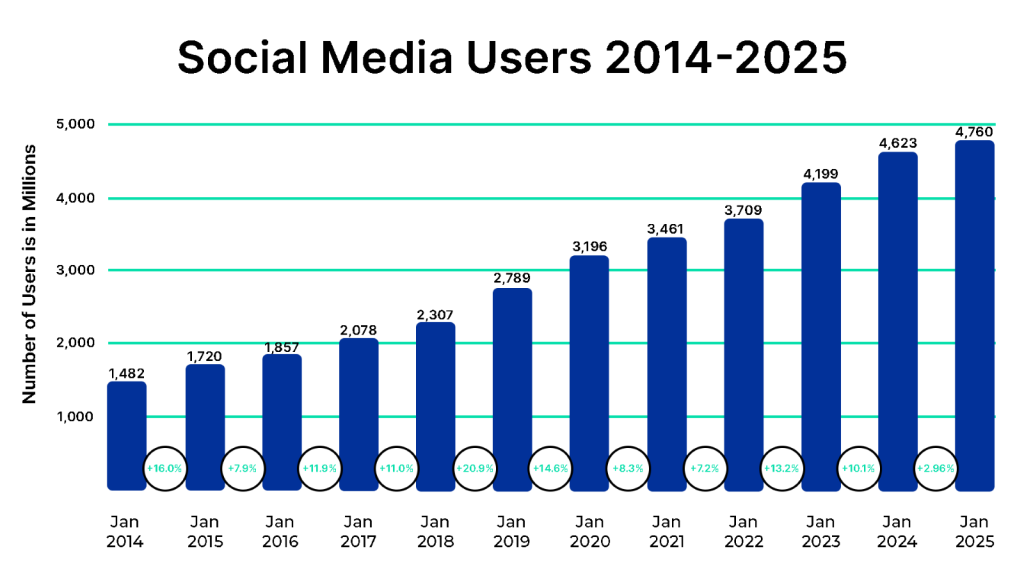
In only a couple of decades, social media has gone from a thing some people tried to something billions of people use daily. And something that has a significant impact on culture, information, relationships, and mental health. The numbers in 2025 make that scale hard to ignore.
Global Adoption and Growth
- 5.66 billion social media user identities worldwide.
- 94.2% social media adoption rate among internet users
- Source: DataReportal
That growth is the headline of the history of social networking sites: it went from a few million users on early networks to billions in a single generation.
Daily Time Spent and Multi-Platform Habits
- 2 hours, 21 minutes per day: average time adults spend using social media (Feb 2025, GWI via DataReportal).
- 6.8 platforms per month: average number of social platforms adults use (Feb 2025, GWI via DataReportal).
- Source: DataReportal – Global Digital Insights
In practice, multi-platform use can look like this: one app for messaging, one for entertainment, one for creators, and one that people open “just to check.”
Social Media Around the World
Reports often provide country-level time-spent data more reliably than continent averages. Here are clear regional snapshots using published benchmarks.
| Region (Snapshot) | Example Benchmark(s) | Daily Time Spent (Hours: Minutes) |
|---|---|---|
| Africa | Kenya; South Africa | 3:43; 3:41 |
| Latin America | Brazil | 3:37 |
| Asia | Philippines; South Korea; Japan | 3:34; 1:06; 0:53 |
| Europe | EU and UK average | 1:48 |
Source: DataReportal, Jan 2024
Cultural norms, smartphone habits, commuting, and messaging apps affect how much we use social media. Plus, it's more than a communication tool; it’s also a primary source of entertainment.
How Social Media Changed the Way We Communicate
Social media made conversations faster and more public, accelerated news cycles, and created new ways to build community. These changes had a downside, too, where privacy, misinformation, and well-being became concerning threats.
- Real-time, global communication: Hashtags, live streams, and instant sharing make it possible to tap into events from around the world.
- News and politics move faster: Social platforms amplify breaking news, but with speed comes risk of misinformation. Now, AI is compounding the risk and proliferation of misinformation.
- Relationships and community building: Users have a global audience to create communities based on any topic, no matter how niche.
- Influencer culture and social commerce: Sellers collaborate with social media influencers to generate content to drive discovery and revenue.
- Downsides to manage: Privacy concerns, scams, and mental health impacts are real and demonstrate the powerful and complicated nature of social media.
What the History of Social Media Tells Us About the Future
In just a few decades, social media went from niche websites to billions of users, always-on feeds, and short-form video that can reach millions overnight. If the past is any indicator, we'll see more AI curation, more format shifts, and stricter rules around content, privacy, and age protections as social media evolves.
Curious how your internet connection shapes your social media experience, especially for video and live streams? Compare providers in your area with BroadbandSearch.
FAQ
When did social media start?
Most timelines point to the late 1990s, when SixDegrees launched in 1997 with profiles and friend lists. (Wikipedia)
What was the first social media platform?
If you define social media as profiles plus a visible network of connections, SixDegrees is one of the earliest clear examples.
How has social media evolved over time?
It evolved from early profile-based networks to feed-based Web 2.0 platforms, to mobile-first visual apps, and now to short-form video and algorithmic discovery that looks more like entertainment than “posting.”
How many people use social media today?
As of 2025, there are well over 5 billion social media user identities worldwide. (Feb 2025, DataReportal)
How has social media changed the way we communicate?
It made communication faster, more public, and more multimedia. It also created new risks around privacy and misinformation, which is why many governments and platforms are now prioritizing safety tools and policy changes.
What will social media look like in the future?
Expect feeds to get even more AI-curated, creators to play a bigger role in what we watch, and tighter rules around privacy and teen safety. The apps will change, but the trend stays the same: social media gravitates toward whatever is easiest to watch, share, and talk about.
What is a social graph?
A social graph is a map based on your social network...friends, followers, connections, and group memberships. Platforms use it to create your feed, make recommendations, and spread content based on likes, comments, shares, and mutual connections.