
Many states around the world contend that individual access to information needs to or should be managed to ensure security or public disorder or to preserve culture. But the price for this security and preservation is often limited access to information. This limitation has led to significant concerns about internet censorship in 2025.
Key Takeaways
- According to Freedom House, the global decline in internet freedom has continued for the 14th consecutive year, as 25 of the 72 countries under analysis currently exhibit some form of online censorship.
- Freedom House also determined that around 80% of global internet users live in countries that exercise some sort of online censorship or surveillance.
- Countries like China, Russia, and Iran possess the harshest conditions for online freedoms. At the same time, online debates are increasing in both the U.S. and EU.
- AI-enabled tools (algorithmic filtering, deepfakes detection, predictive censorship) are being used by both governments and platforms to shape online discourse.
What Is Internet Censorship?
In brief, internet censorship can be defined as anything that limits public access to online information. Today, the term refers to more than just filtering online sites. It encompasses a complex landscape involving government regulation, platform censorship, stealth filtering tactics, connection-impeding strategies (internet shutdowns), and algorithmic filtering using AI algorithms.
Why Does Internet Censorship Matter?
“Information is the currency of democracy.” These famous words by Thomas Jefferson are truer today than ever before. In 2025, access to and control of the internet has emerged as one of the hallmark characteristics of our digital era. After all, the freedom to say/write and hear/read whatever we want dates back to the very foundation of the US as a country.
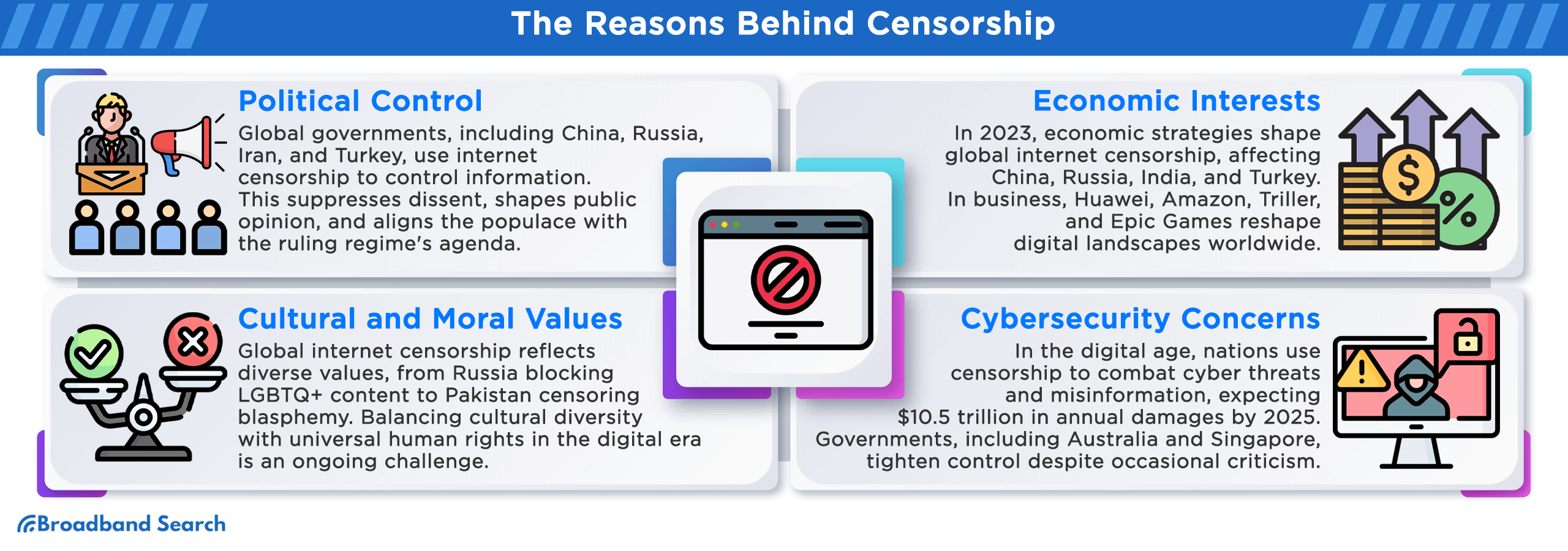
The idea of a global internet (or world wide web) is rapidly coming apart. We are living through the emergence of a “splinternet,” which is driven by an international fragmentation of the internet ecosystem that allows different regions to enforce their own set of rules. This has led many countries to experience diverse internet censorship problems as detailed below. So if you are interested in free speech or international business, you need to stay informed.
The Global State of Internet Freedom
To take the temperature of global internet freedom today, we must examine recent developments in internet censorship and the places where internet freedom still thrives.
How Has Internet Censorship Changed in 2025?
The problem of internet censorship is worse than ever today. Web liberty around the world has fallen for the 14th year in a row according to Freedom House’s Freedom on the Net 2024: The Struggle for Trust Online. The 72 nations surveyed by Freedom House represent 87% of global internet users. Of the 45 democratic countries surveyed, only 18 improved their embrace of cyber liberties in 2024.
Gigazine recently published one of the most telling statistics about the current state of internet censorship worldwide. Quoting research by Access Now, it reported that there were 296 recorded internet shutdowns in 2024 in 54 countries. This was an increase from 283 recorded in 2023. Internet shutdowns are often imposed for political reasons when there are elections, protests, or conflicts.
Who Is Most Affected By Internet Censorship in 2025?
In terms of global trends in online freedoms, there are major regional differences in 2025. High repression jurisdictions include mainland China, Russia, Iran, Myanmar, and Belarus. Countries rated as emerging or hybrid restriction nations include India, Turkey, and Egypt. Nations classified as regulated democracies include the United States and the European countries, which are majorly involved in online platform regulation. Other jurisdictions, like those in sub-Saharan and Asian regions, are relatively stable or are witnessing improvement.
In its Freedom on the Net 2024 report, Freedom House also reports that 80% of internet users live in a nation that exercises some type of internet censorship. Although complete global analysis of this data leaves a considerable margin of error, this means that roughly 4 in 5 users cannot reliably access the full spectrum of content and information available on the internet.
In contrast, only a few nations are retaining or strengthening online liberties. The United States, for example, continues to protect individual rights by supporting robust internet freedom. But challenges to this freedom are on the rise.
Which Countries Are Most Affected By Internet Censorship?
Countries with high populations, such as the United States, and countries with strict government oversight, such as China and Russia, experience greater online censorship. Below is a rough geographic snapshot of online liberty around the globe in some ‘noteworthy’ nations:
United States
In the United States, there isn’t a state-administered “firewall” between major platforms per se, but online freedom faces emerging challenges nonetheless. Public debates over Section 230 of the Communications Decency Act and proposed bans on TikTok access show that online regulation is fast-becoming online moderation in practical terms. Content moderation using AI is another cause for concern in the US. More frequently, publishers are using algorithms to identify “misinformation” or “harmful” content. Although its aim is to safeguard users, there seems little accountability or transparency in these algorithms.
China
Among major countries, China continues to host the most restrictive internet environment in the world. Under its Great Firewall umbrella, the Chinese government not only bans international sites (Google, Facebook, Twitter), but it also monitors encrypted communications, using AI and biometric surveillance to check user behavior. Accounts reported in ‘Cybersecurity’ documents published by Citizen Lab or ‘Freedom House’ indicate that search terms related to contested incidents or leaders are removed or ‘censored’ from cyberspace.
Russia
Russia’s censorship regime has increased in severity during times of war, especially since its invasion of Ukraine. “Sovereign”-internet legislation includes requirements for data to be stored on local servers for Russian users, fast removals of content, and “suffocating independent media online,” according to Human Rights Watch. At the same time, the rollout of the sovereign “Runet” internet increases Russia’s ability to operate in isolation from global web traffic and adds a layer of structural control.
India
According to Access Now, India recorded the 2nd most internet shutdown incidents globally—84 in 2024. The Indian government has introduced tough guidelines for social media platforms, which mandate the removal of content within specified intervals or face withdrawal of licenses.
European Union
In the EU, censorship takes a different shape. The Digital Services Act (DSA) and AI Act are redefining accountability, censorship obligations, and data regulation for online platforms. Although these policies aim to control undesirable online content like misinformation and hate speech, critics warn that heavy regulation may empower private platforms to act as “gatekeepers” to reduce user voice and infringe upon free speech provisions.
Iran
Iran continues to enforce strict moral and political censorship by limiting or cutting off internet access in areas of protest. Citizens in Iran have used VPNs to bypass internet censorship by masking their traffic and rerouting it through remote servers. But the National Information Network, run by the Iranian government, still maintains a highly regulated online environment.
Other Regions
- Africa: The use of internet censorship has increased dramatically, particularly during contentious elections or social unrest cycles. The Guardian reported 21 internet shutdowns in 15 African nations during 2024.
- Latin America: Creating a tricky environment, Brazil is pushing anti‑misinformation laws, while Mexico resists stricter regulation and content bans.
How Do Governments Enforce Censorship?
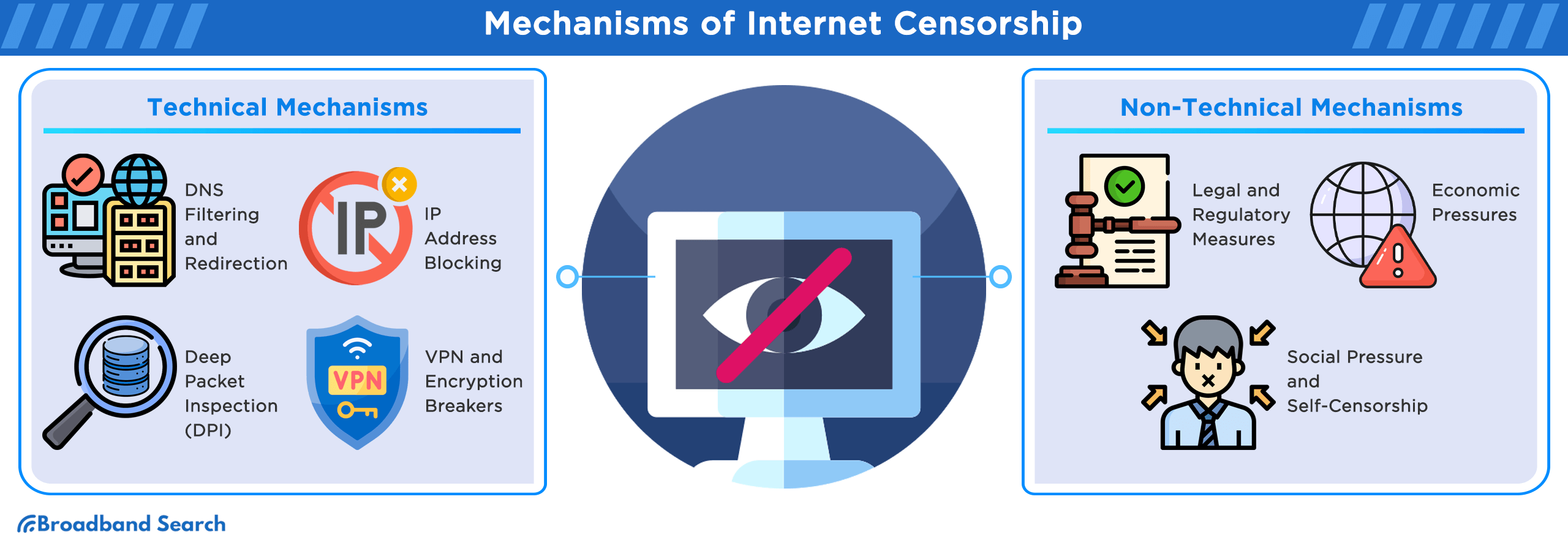
Governments use a range of technical, legal, non-technical, and cutting-edge means to limit internet access and censor internet content.
Technical Methods
DNS filtering and redirection
- What it is: Blocking or hijacking domain name lookups for specific websites.
- How it works: When users type a blocked site’s address, the DNS server refuses to resolve it or sends them to an alternate page.
- Why it matters: Sites can be made effectively unreachable for most users without shutting down the whole internet.
IP address blocking
- What it is: Blocking access to specific IP addresses or entire IP ranges.
- How it works: Network routers and firewalls drop traffic to and from targeted addresses, often affecting whole platforms or apps.
- Why it matters: Entire services—like messaging apps, news outlets, or social networks—can be taken offline in a region with a single rule.
Deep packet inspection (DPI)
- What it is: Advanced traffic inspection at a very granular level.
- How it works: Specialized equipment analyzes network packets (including metadata and any unencrypted content) to identify protocols, keywords, or services, then blocks, throttles, or flags them.
- Why it matters: DPI enables highly targeted censorship and surveillance, rather than blunt, all-or-nothing blocking.
Interference with VPNs and encryption
- What it is: Efforts to weaken, block, or punish the use of tools that hide or protect online activity.
- How it works: Authorities may block VPN endpoints, pressure providers, or restrict encrypted protocols.
- Why it matters: When VPNs and strong encryption are disrupted, users lose key tools for accessing global information and protecting their privacy.
Legal and Non-Technical Methods
Content laws and regulatory pressure
- What it is: Laws and regulations that require platforms or users to remove or avoid certain content.
- How it works: Governments issue takedown orders, impose fines, or threaten jail time for “illegal” speech or failure to comply.
- Why it matters: Legal risk pushes platforms and individuals to remove content quickly—sometimes beyond what the law strictly requires.
Intimidation and self-censorship
- What it is: Social and political pressure that encourages people to silence themselves.
- How it works: Journalists, activists, and ordinary users may face harassment, surveillance, or threats if they speak out.
- Why it matters: Even without formal bans, fear can shrink the space for free expression and public debate.
Economic levers
- What it is: Financial pressure on companies that host or transmit online content.
- How it works: Governments threaten to fine, tax, or block platforms that do not quickly remove flagged material.
- Why it matters: To protect their business, companies may over-comply with censorship demands, limiting what users see and share.
AI and Emerging Technologies
AI-driven content moderation and surveillance
- What it is: Use of algorithms to scan and act on huge volumes of online content.
- How it works: Machine-learning models flag “extremist,” “harmful,” or “misleading” posts for removal, downranking, or human review.
- Why it matters: Automation makes large-scale censorship possible but can also introduce bias, over-blocking, and opacity.
Big data analytics and predictive monitoring
- What it is: Combining large datasets with AI to detect patterns in online behavior.
- How it works: Authorities analyze posts, connections, and engagement to identify emerging protests, narratives, or “risky” groups.
- Why it matters: This enables pre-emptive or predictive censorship, where speech is limited before movements fully form.
Quantum computing and future encryption challenges
- What it is: Next-generation computing power that could break common encryption schemes.
- How it works: As quantum capabilities mature, some existing cryptographic tools may become easier to crack or bypass.
- Why it matters: If encryption becomes weaker in practice, governments could gain greater access to private communications and expand digital surveillance.
What Role Does AI Play in Internet Censorship?
Nation-states use AI for content moderation, automatic removals, prediction-based censorship, and user sentiment analysis in private and public sectors.
The benefits are immense, but AI poses dangers as well. Algorithmic bias may suppress minority voices; errors may lead to over‑blocking; and lack of transparency can make redress impossible.
The use of “Deepfakes” introduces another dangerous dynamic. Increased use of AI to produce fake audio or video could manipulate elections, silence critics, or both. In response, many countries are introducing “deepfake laws,” first‑movers in a digital arms race over truth and narrative control.
What Is the “Splinternet?
We are witnessing a “splinternet”: a series of interconnected smaller networks called “internetworks”, which technically divide the world wide web into separate regional silos. The internet once promised a borderless global system, but those ideals are now being pushed to the limits.
The Great Firewall of China is just one example. Others are Runet in Russia, digital sovereignty policy efforts in the EU, and data storage requirements in India. The splintered nature of the internet can have profound implications for governments, businesses, and private citizens alike. It can either foster global trade and the free exchange of information, or it can stifle it.
The Impacts of Internet Censorship
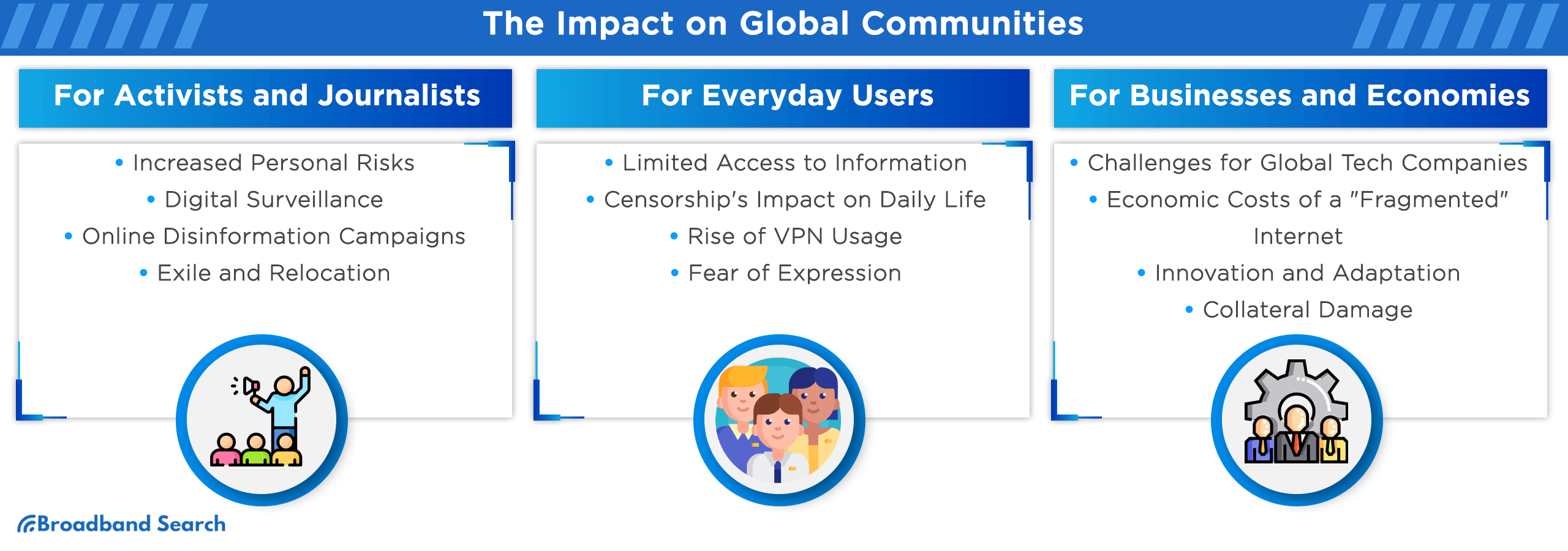
From content restriction, threats of violence, to economic loss, censorship can affect anyone who uses the internet for private or public use.
Everyday Users
Real-world consequences of censorship might include restrictions on access to information, social media, educational resources, and entertainment. In some areas, users resort to using VPNs or proxies, but these are now often banned too.
Activists and Journalists
People who challenge power structures or report unfavorable stories about them often face censorship as well as punishment. In some cases, they might be imprisoned, physically attacked, or even killed. According to Freedom House’s Freedom on the Net 2024, people in at least 43 countries were assaulted or killed as a result of their online activities. Surveillance, arrests, and shutdowns of communications are common tools of repression.
Businesses and Economies
Digital fragmentation and national sovereignty make cross-border services, cloud computing, and data movements complex. Global technology firms are presented with tough decisions regarding compliance with local censorship norms or adherence to universal values concerning free speech. The economic cost of fragmentation is real, disrupting trade, innovation, and the open internet economy.
The Future of Internet Freedom
A few major trends become evident through 2030:
- Sovereign networks vs. open internet: Expect more countries to create digital ecosystems that value control over openness.
- AI-powered moderation: Automated systems will handle more content decisions—raising concerns over fairness and accountability.
- Data localization and platform regulation: Nations are expected to push local data storage and special laws for tech platforms.
- Quantum computing and encryption fights: As quantum technology matures, classical encryption methods might become so outdated that governments could conduct surveillance or other activities that undermine privacy.
But the pressing issue remains: Will international action coalesce to secure online freedom, or will increased fragmentation set the stage for multiple, closed digital worlds?
Censorship or Freedom? The Digital Crossroads of 2025
As we cast our eyes across the digital horizon in 2025, one thing is clear: the choices we make now will define how open our online world remains.
We need to ask ourselves these questions: Can we live with our information being filtered or turned off at pivotal times? Will we demand transparency and accountability from governments who control our internet?
Organizations like Citizen Lab, Reporters Without Borders, or Freedom House raise awareness regarding censorship issues, advocate for online freedom, and promote an open internet. Supporting watchdog groups like these is crucial as we stand at this digital crossroads.
At the end of the day, the internet is more than a private tool. It’s a public space. And its freedoms shape everything from our politics to our economy to our culture to our individual liberties.
FAQ
Why does global internet freedom continue to decline year after year?
The decline is a result of increased government censorship, internet shutdowns related to elections, use of AI technology to filter content, and a shrinking environment to safely exercise online freedoms.
What is the “splinternet”?
The term “splinternet” describes how a globalized internet could break up into regional or national “internets,” which are defined by varying conditions.
What percentage of global internet users live in nations that impose some measure of censorship?
Approximately 80% of those who access the World Wide Web live in a country where there is some sort of censorship.