
In 2026, the best no-contract internet providers are T-Mobile Home Internet, Starlink, and Google Fiber — all of which offer true month-to-month service with no early termination fees (ETFs). Most major ISPs, including Xfinity and Spectrum, now offer contract-free options alongside their standard term plans, though these often carry slightly higher monthly rates than their 12- or 24-month counterparts. For the best long-term value, look for price-for-life guarantees that lock your no-contract rate permanently rather than resetting after a promotional period.
No-Contract Internet Plans in 2026: Quick Answer
No-contract internet plans fall into three categories: 5G home internet (T-Mobile, Verizon), which is contract-free by design and requires no credit check; fiber providers (Google Fiber, Quantum Fiber, Frontier) that offer month-to-month billing with the best long-term price stability; and satellite options (Starlink) that serve rural households with no commitment required. The most important distinction when comparing no-contract plans is not the monthly rate — it's whether the rate is permanently locked or introductory, whether equipment is included or purchased separately, and whether the plan's speed tier matches what's available under a contract with the same provider. For households that qualify, the federal Lifeline program can reduce the monthly cost of many no-contract plans by up to $9.25/month regardless of which provider you choose.
At a Glance: No-Contract Internet in 2026
Best overall | T-Mobile Home Internet — flat monthly rate, no fees, no credit check |
Best for speed | Google Fiber — symmetrical gigabit speeds, no contract, no data caps |
Best for rural | Starlink — LEO satellite, month-to-month, available where cable can't reach |
Best for budget | Xfinity Prepaid — starts at $30/month, no credit check, pay-as-you-go |
Best for low income | Lifeline-eligible providers — federal subsidy applicable to qualifying no-contract plans |
What to watch | Introductory pricing, equipment purchase requirements, and automatic rate increase clauses |
When contracts win | If you plan to stay 2+ years and want the lowest monthly rate with bundled perks |
Key Takeaways: What to Know Before You Sign Up
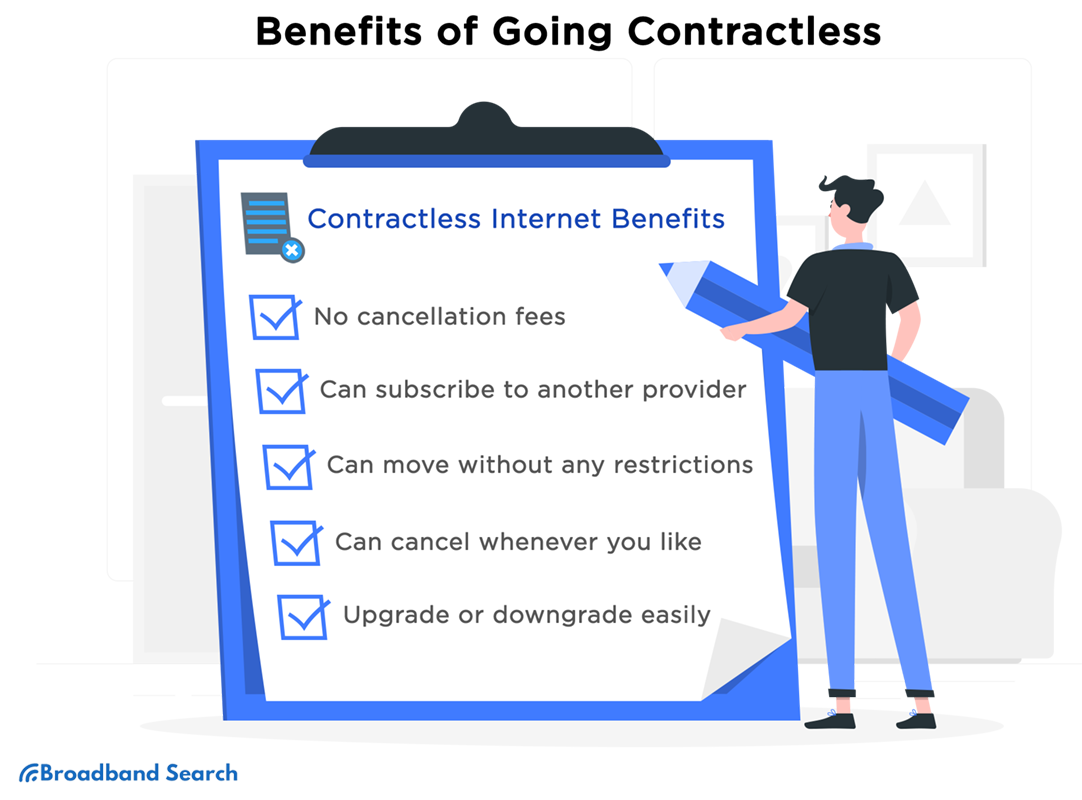
- The Flexibility Factor: No-contract plans let you cancel anytime without paying early termination fees — on standard cable and fiber agreements, these can add up to hundreds of dollars depending on how much time remains on the contract.
- True vs. Hybrid: "Contract-free" doesn't always mean a permanent price. Verify whether your monthly rate is an introductory offer that resets after 12 months or a genuinely locked rate.
- 5G Is Leading the Shift: 5G home internet is the fastest-growing broadband segment, with T-Mobile and Verizon together serving over 13 million FWA customers — largely because both providers built their home internet businesses around month-to-month service from day one.
- Hidden Costs Add Up: Watch for equipment purchase requirements, activation fees, and installation charges that can offset the monthly flexibility of a no-contract plan.
- No Credit Check Options Exist: Many 5G home internet and prepaid plans skip the hard credit pull entirely — a meaningful advantage for households with limited credit history or those in transitional living situations.
Find Out Which No-Contract Providers Are Actually in Your Area.
The whole point of going no-contract is staying in control. Enter your zip and see which flexible plans are available at your address so your first decision is an informed one. Not one you'll want to undo.
Is No-Contract Internet Worth It?
No-contract internet is worth it if flexibility matters more to you than getting the lowest possible monthly rate. For renters, students, frequent movers, or anyone in a transitional living situation, the ability to cancel service on 30 days' notice without paying a penalty is a genuine financial protection.
For households planning to stay in one place for two or more years, a term contract often delivers a lower monthly rate; sometimes $10–$20 less per month — plus bundled perks that no-contract plans frequently exclude.
The Benefits of Going Contract-Free
Flexibility to move without penalty. No-contract internet is the practical choice for anyone who may relocate within the next year — renters, college students, military households, and remote workers who move between cities. Standard cable and fiber contracts lock you in for 12–24 months, and breaking them early triggers ETFs that can add up quickly depending on how much time remains.
No credit check on many plans. Most 5G home internet providers and prepaid ISPs do not require a hard credit inquiry to sign up. This is a meaningful distinction for households that have been denied service from traditional cable or fiber providers due to credit requirements, or for anyone who simply doesn't want a hard pull on their credit report.
Freedom to switch if service quality drops. Without a contract, you aren't legally obligated to stay with a provider whose speeds become inconsistent, whose customer service is unresponsive, or whose pricing changes. You can evaluate your options month to month and switch whenever a better plan becomes available in your area.
Trade-Offs to Consider
Price instability. Without a contract, your ISP can raise your monthly rate with as little as 30 days' notice. Term contracts typically lock in your promotional rate for the contract period. If rate stability matters, look specifically for providers offering a "price for life" or "price lock" guarantee on their no-contract plans — these exist but require reading the fine print carefully.
Higher base monthly rates. No-contract plans are often priced higher per month than their contract-term equivalents at the same speed tier. Over a 24-month period, that premium can exceed the early termination fee you're trying to avoid — making it worth running the math before defaulting to flexibility.
Upfront equipment costs. Some no-contract providers require you to purchase your gateway or modem outright — typically in the $150–$300 range — rather than paying a subsidized monthly rental fee. This shifts the cost from ongoing to upfront, which can be a barrier depending on your budget.
Fewer bundled perks. Free streaming services, discounted TV packages, and other promotional add-ons are frequently reserved for customers who sign long-term agreements. No-contract customers on the same physical network typically pay more and receive fewer extras.
Limited plan tiers on some prepaid options. Prepaid and no-contract plans don't always offer the same speed tiers as their contract counterparts. Some providers reserve their highest speed tiers for term-contract customers, so verify that the speed you need is actually available on the month-to-month plan before signing up.
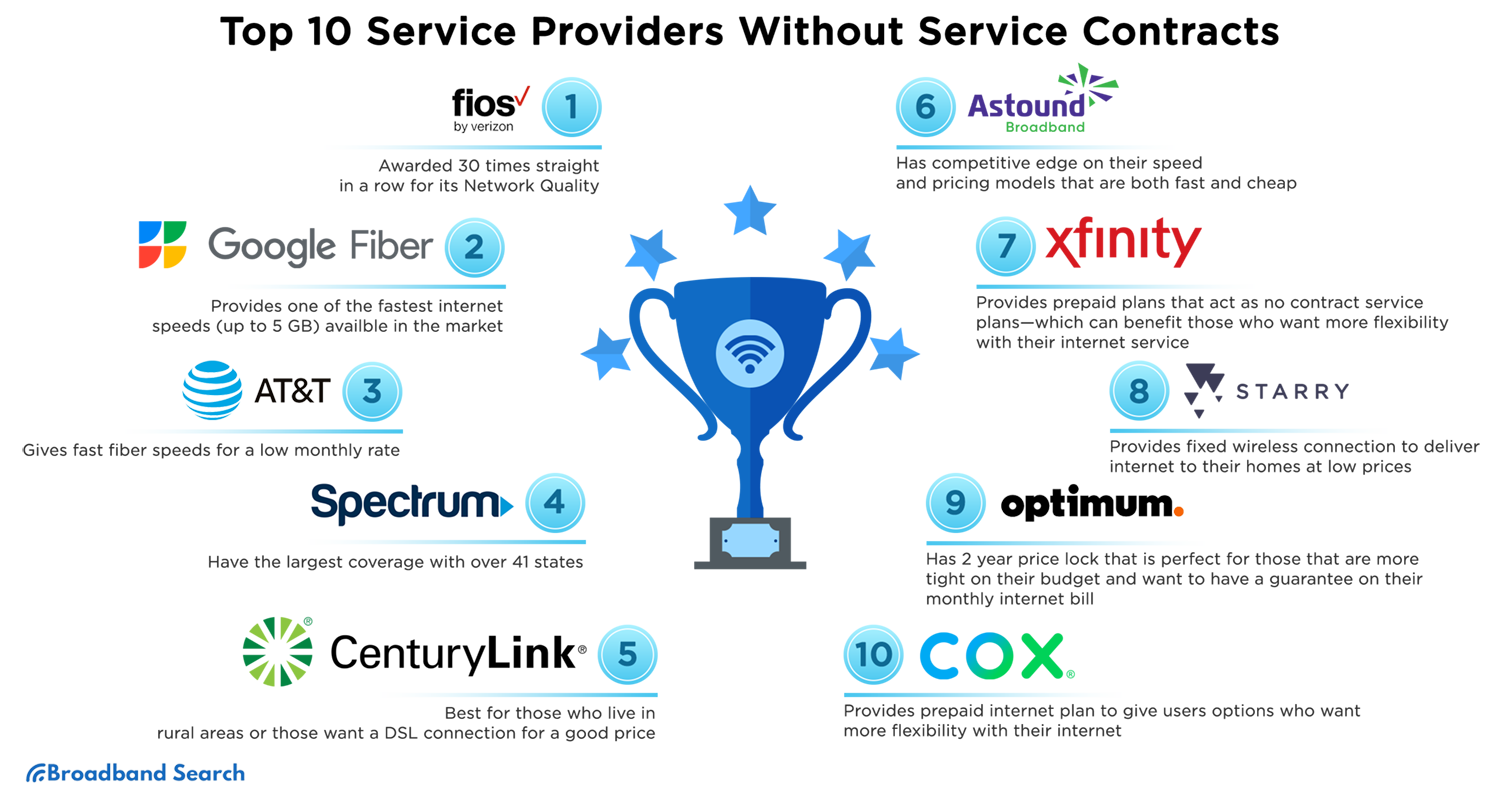
Which ISPs Offer the Best No-Contract Plans? Top 10 Ranked
The 10 providers below offer verified no-contract or month-to-month options as of 2026. Starting prices reflect the lowest available no-contract tier; actual rates vary by location and plan selection.
Rank | Provider | Type | Best For | Starting Price | Starting Speed | Data Cap | Equipment Fee |
1 | 5G | Flat monthly rate, no fees | $50/mo | 72 Mbps | None | Included | |
2 | Fiber | Symmetrical speeds, no caps | $70/mo | 1,000 Mbps | None | Included | |
3 | LEO Satellite | Rural flexibility | $120/mo | 25 Mbps | None | $599 (hardware) | |
4 | 5G | Mobile bundling savings | $50/mo | 300 Mbps | None | Included | |
5 | Cable | Wide availability | $50/mo | 300 Mbps | None | $5/mo rental or BYO | |
6 | Cable | Prepaid pay-as-you-go | $30/mo (Prepaid) | 50 Mbps | 1.2 TB (standard plans) | $30/mo rental or BYO | |
7 | Cable | No-contract, no surprise bills | $50/mo | 100 Mbps | Unlimited | Included | |
8 | Fiber | Price-for-life guarantee | $50/mo | 200 Mbps | None | $15/mo rental or BYO | |
9 | Fiber | Local fiber access | $40/mo | 200 Mbps | None | Included | |
10 | Fiber | High-speed value | $45/mo | 500 Mbps | None | Included |
Prices and speeds verified at time of publication. Always confirm current rates at your address — availability and pricing vary by market.
Best No-Contract Internet by Use Case
Best for Gamers: Google Fiber delivers the symmetrical upload and download speeds and sub-15ms latency that competitive gaming demands, with no contract and no data caps. If Google Fiber isn't available in your area, T-Mobile Home Internet is a strong second option for its flat pricing and low average latency on its 5G network.
Best for Remote Workers: Quantum Fiber's price-for-life guarantee makes it the most financially predictable no-contract option for home office setups. Symmetrical speeds on its fiber plans support video conferencing, large file transfers, and cloud-based work tools without the upload bottleneck that cable and 5G plans can create under load.
Best for Rural Users: Starlink remains the strongest no-contract option for households outside the cable and fiber footprint. Its LEO satellite technology delivers 25–220 Mbps with 25–50ms latency — playable for gaming and sufficient for streaming — with no long-term commitment required. The hardware cost ($599) is the primary barrier.
Best for Budget: T-Mobile Home Internet's $50 flat monthly rate includes equipment, has no hidden fees, and requires no credit check. Xfinity Prepaid is the lowest entry point at $30/month for a pay-as-you-go structure with no contract and no credit check.
Best for Temporary or Transitional Housing: Cox StraightUp Internet is built specifically for short-term commitment — a flat monthly rate, no contract, no credit check, and included equipment. It's a strong fit for temporary relocations, short-term rentals, or households between permanent addresses.
Best for College Students: Xfinity Prepaid and T-Mobile Home Internet both offer no credit-check signup and monthly billing that aligns with academic calendar flexibility. Neither requires a long-term commitment, making them practical for students who move between apartments each semester.
Best for Seniors on Fixed Incomes: Quantum Fiber's price-for-life guarantee prevents rate increases, which is a meaningful protection for households on fixed budgets. Lifeline-eligible households may also qualify for additional monthly subsidies on top of the no-contract plan's base rate — see the low-income section below.
Affordable No-Contract Options for Low-Income Households
No-contract flexibility shouldn't be a privilege reserved for high-income households. Several federal programs and provider-specific plans make month-to-month internet accessible at reduced costs.
The Lifeline Program is a federal benefit administered by the Universal Service Administrative Co. (USAC) that provides eligible low-income households with a monthly subsidy — currently up to $9.25/month, or up to $34.25/month on Tribal lands — that can be applied to qualifying internet plans. Lifeline is not limited to contract plans; it can reduce the monthly cost of many no-contract and prepaid options. You can check eligibility and apply at lifelinesupport.org.
Xfinity Prepaid starts at $30/month with no credit check, no contract, and no service agreement — making it one of the most accessible no-contract options for households that don't qualify for subsidized programs but need flexibility without a credit barrier.
T-Mobile Home Internet also has no credit check requirement and a flat $50/month rate with no hidden fees. For households near a strong T-Mobile 5G tower, it's one of the cleanest no-contract options available regardless of income level.
ACP (Affordable Connectivity Program): Note that the ACP program, which previously provided up to $30/month in additional broadband subsidies, ended in 2024. Lifeline remains active. Check USAC for the most current federal assistance programs available.
How Do You Get Internet Without a Contract? Step-by-Step
- Look specifically for prepaid or month-to-month tiers. Most ISP websites default to showing contract plans first. Navigate to the provider's plan selection page and look for "Prepaid," "No Contract," or "Month-to-Month" filter options. If those filters aren't visible, call the provider directly — some no-contract options aren't prominently featured online.
- Toggle the month-to-month option during checkout. When using an ISP's online ordering tool, the default selection is typically a 12- or 24-month agreement. Before completing your order, look for a radio button or toggle that lets you select a no-contract billing option. The price will usually be higher, but the commitment is yours to cancel at any time.
- Choose a 5G home internet provider. T-Mobile and Verizon built their home internet businesses around no-contract service from the start. If 5G coverage is strong at your address, these providers offer the simplest path to month-to-month internet with no ETF risk.
- Bring your own equipment. Many no-contract providers allow — and sometimes require — you to use your own modem or router rather than renting one from them. Purchasing a compatible modem outright eliminates the monthly rental fee ($5–$15/month) and is often cost-neutral within 12–18 months. Verify compatibility with your specific provider and plan tier before purchasing.
Finding Your Best No-Contract Match
The right no-contract plan depends on two things: how long you plan to stay at your current address and how much month-to-month flexibility is worth to you financially. If you're moving within the year, the monthly premium over a contract plan is almost always the better bet — you're paying for protection against ETFs and the freedom to upgrade as your needs change. If you're settling in for two or more years, run the math on the contract vs. no-contract price difference before defaulting to flexibility.
Before committing to any plan, read the fine print carefully for the following: introductory pricing periods and when they expire, automatic rate increase clauses, equipment purchase or rental requirements, data caps on entry-level tiers, service area limitations that could affect your coverage, and whether the price-for-life or price-lock language in the offer is contractually binding or just marketing language.
Ready to see which no-contract providers serve your address? Check our internet providers by address tool to compare available plans in your area today.
See Every Internet Provider Available Where You Live.
BroadbandSearch lists every provider available at your address, contract or no-contract, so you can compare all your options before you sign anything.
FAQ
Can I Switch From a Contract Plan to a No-Contract Plan?
You can switch, but the timing and cost depend on where you are in your current contract term. If you're still within your agreement period, switching to a no-contract plan with the same provider may be possible — but it will likely trigger an early termination fee equal to the remaining months on your contract multiplied by the ETF rate (typically $10–$20 per month remaining). If you're switching providers entirely, that ETF still applies. The cleanest path is to wait until your contract expires — many providers send renewal notices 30–60 days before the end of the term, which is the window to renegotiate or switch without penalty.
Do I Still Need a Credit Check for No-Contract Internet?
It depends on the provider and plan type. Most traditional cable and fiber providers — including Xfinity, Spectrum, and Cox — still run a soft or hard credit check during signup, even for no-contract plans. However, 5G home internet providers like T-Mobile and Verizon, as well as prepaid options like Xfinity Prepaid, typically skip the credit inquiry entirely. If avoiding a credit check is a priority, filter your search to 5G home internet and prepaid options specifically — these are the strongest "no credit check internet" searches in 2026.
Is Starlink the Only No-Contract Satellite Option?
No, but it's the most flexible. Starlink offers true month-to-month service with no contract requirement, though the $599 hardware cost is a significant upfront barrier. Viasat and HughesNet, the two major GEO satellite providers, have historically required 24-month contracts — though both have introduced shorter-term options in some markets. The more important distinction for most users is performance: Starlink's LEO technology delivers 25–50ms latency and speeds up to 220 Mbps, while HughesNet and Viasat GEO connections produce 600ms+ latency that makes real-time gaming and video calling difficult regardless of contract length.
What Is the Cheapest No-Contract Internet Plan?
Xfinity Prepaid is currently the lowest entry point for no-contract home internet, starting at $30/month for a pay-as-you-go plan with no credit check and no service agreement. T-Mobile Home Internet starts at $50/month and includes equipment with no hidden fees. For households that qualify, combining a no-contract plan with the Lifeline federal subsidy (up to $9.25/month) can reduce costs further. The cheapest option in your specific area will depend on which providers serve your address — use a zip code lookup tool to see what's actually available at your location.
Can I Use My Own Router With No-Contract Internet?
Generally yes, and doing so is often a smart financial move. Most cable, fiber, and 5G providers allow — and sometimes encourage — customers to bring their own compatible modem or router rather than paying a monthly rental fee. Router rental fees typically run $5–$15 per month, meaning a $100–$150 compatible router pays for itself within 10–18 months. Before purchasing equipment, verify your specific router or modem's compatibility with your provider and plan tier — not all hardware works with all ISPs, and some fiber and 5G plans require proprietary gateways that cannot be replaced with third-party equipment.
Is No-Contract Internet Available in Rural Areas?
Yes, primarily through Starlink and T-Mobile Home Internet. Starlink's LEO satellite service reaches virtually any location with a clear view of the sky — it's currently the strongest no-contract option for rural households that lack cable and fiber infrastructure. T-Mobile Home Internet is available in many rural and suburban areas with strong 5G or LTE coverage, though actual availability depends on tower proximity and signal strength at your specific address. Fixed wireless providers also serve many rural markets on a no-contract basis. Use a zip code tool to check which no-contract providers are available at your address before assuming options are limited.