
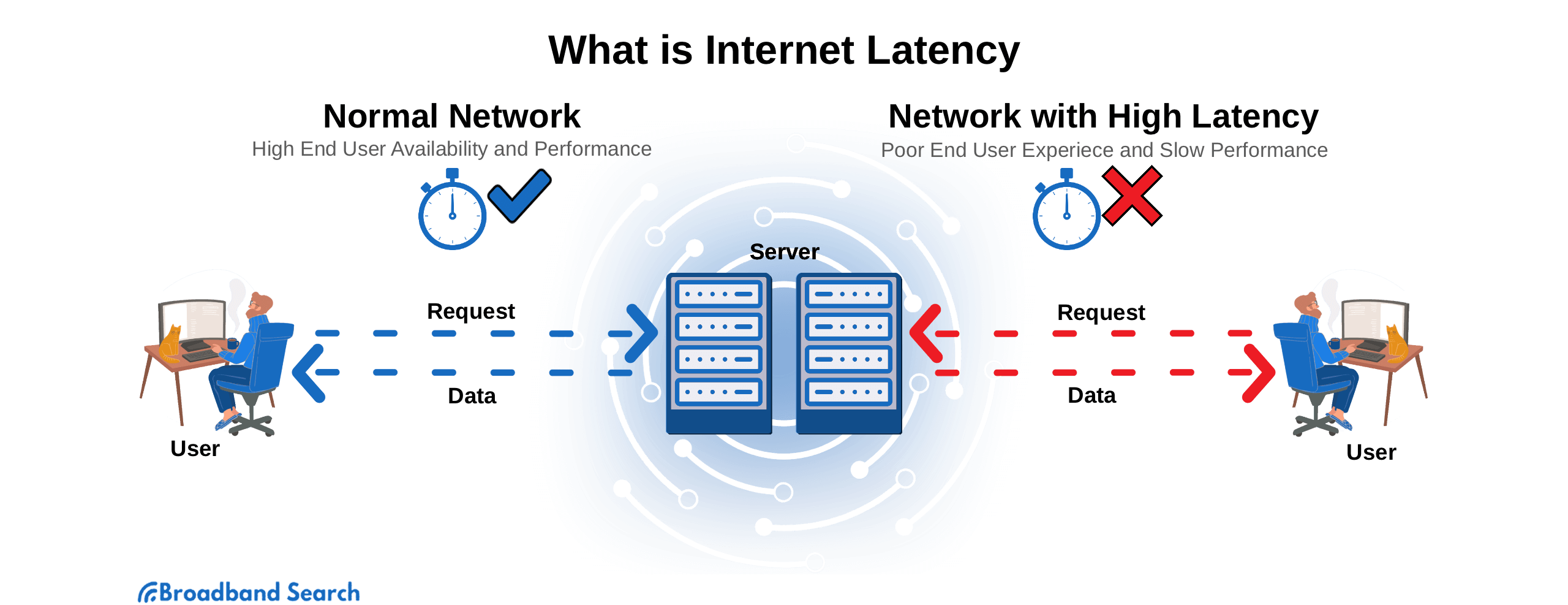
If your game character keeps snapping back to where they just were, your shots aren't registering, or your video calls keep freezing mid-sentence, you're dealing with high latency — the real culprit behind most lag complaints. In 2026, internet speeds are faster than ever, but latency remains the metric that separates a smooth online experience from a frustrating one. This guide explains what latency is, why it gets high, how to diagnose the source, and exactly what to do to fix it — whether you're a competitive gamer, a remote worker, or just tired of choppy video calls.
At a Glance: What Is High Latency?
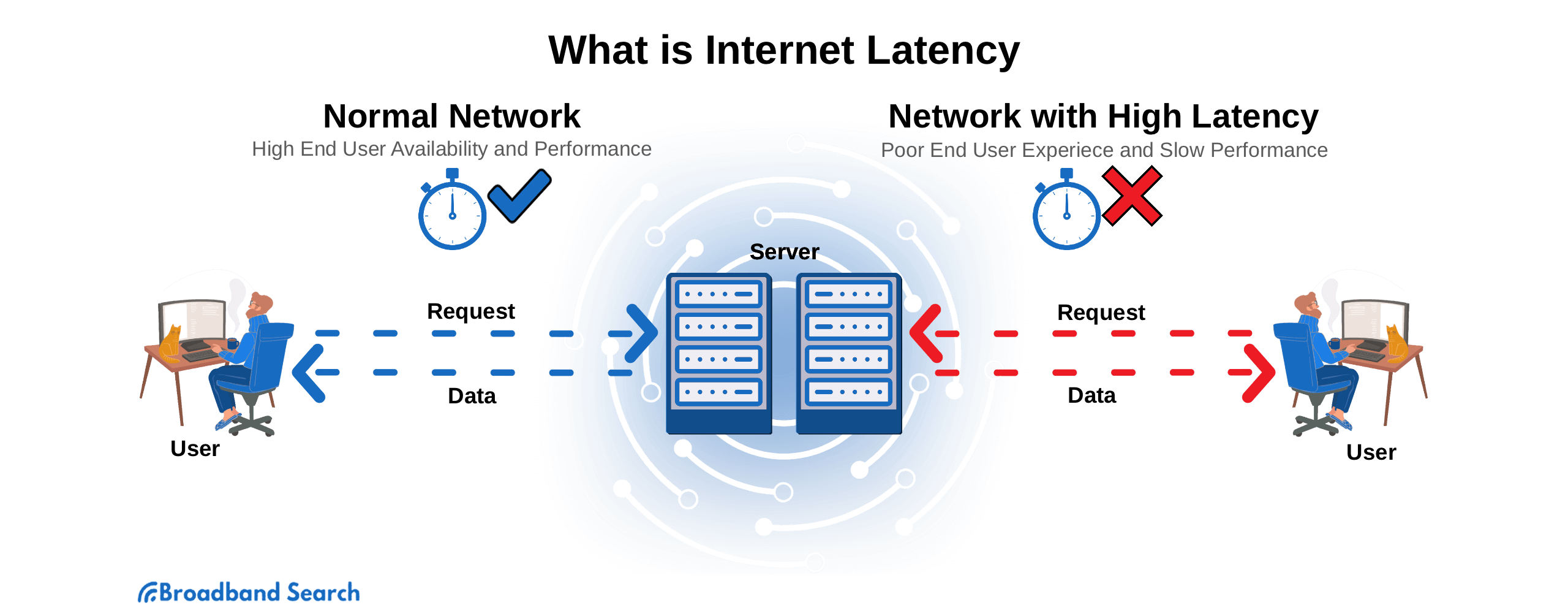
High latency — commonly called "lag" — is the delay between sending data from your device and receiving a response from a server. It's measured in milliseconds (ms). For real-time tasks like gaming and video calls, that delay is the difference between a seamless experience and one that feels broken. A good latency is under 30ms for gaming; anything consistently above 100ms will cause noticeable stuttering, input delay, or audio sync issues.
You can usually fix high latency by switching to a wired Ethernet connection, closing background apps and downloads, power cycling your modem and router, or enabling Quality of Service (QoS) settings to prioritize time-sensitive traffic on your network.
Key Takeaways: Is High Latency Good or Bad?
- High latency is bad for real-time tasks: For gaming, video calls, and cloud streaming, low latency (under 30ms) is the target. High latency (over 100ms) causes rubber-banding in games, audio desync on calls, and input lag across the board. For less time-sensitive tasks like web browsing or file downloads, latency matters far less.
- Test your connection: Use the TestMySpeed to get an accurate reading of your ping, jitter, and latency under load — not just your download speed.
- Distance is the #1 unfixable cause: The physical distance between your home and the game or application server determines a baseline latency floor that no router or plan upgrade can eliminate. Connecting to geographically closer servers is the only workaround.
- Wired connections make an immediate difference: Switching from Wi-Fi to a Cat 6 Ethernet cable typically reduces latency by 10–20ms and eliminates the interference-driven jitter that wireless signals introduce.
- Latency and jitter are different problems: Latency is the consistent delay in your connection; jitter is the variance in that delay over time. A ping that swings from 20ms to 120ms back to 30ms causes rubber-banding and packet loss even when the average looks acceptable. Both
Troubleshooting Your Lag: A Quick Diagnostic Flow
Before adjusting any settings, follow this flow to identify where your latency problem is actually coming from. Skipping this step means guessing — and guessing wastes time.
- Is it one device or all devices? If lag only affects one device, the problem is local to that device — check for background app activity, pending system updates, or outdated network drivers. If all devices are affected, the issue is with your router, modem, or ISP connection.
- Is it constant or does it spike? Consistently high latency across the day points to a structural issue — ISP routing problems, distance from the server, or an underpowered connection type. Latency that spikes at certain times, then recovers, usually means network congestion.
- Is it time-of-day dependent? If lag appears between 7–11 PM and clears up in off-peak hours, your ISP's local network is experiencing peak-hour congestion — demand on the shared infrastructure in your area is exceeding capacity during those windows.
- Is it server-location dependent? Run a speed and latency test connecting to a local server, then a distant one. If your latency drops significantly on the local test, the issue is geographical — you're routing to a far-away server. Switch to a closer region in your game's server settings if that option is available.
Target Latency by Activity
Activity | Excellent | Playable | Poor |
Competitive Gaming | < 20ms | 20ms – 60ms | > 100ms |
Cloud Gaming | < 30ms | 30ms – 75ms | > 120ms |
Video Calls | < 50ms | 50ms – 100ms | > 150ms |
Web Browsing | < 100ms | 100ms – 200ms | > 300ms |
4K Streaming | < 150ms | 150ms – 250ms | > 500ms |
Latency vs. Ping vs. Jitter: What's the Difference?
These three terms are often used interchangeably, but they measure different things — and understanding the distinction helps you diagnose the right problem.
These three terms are often used interchangeably, but they measure different things — and understanding the distinction helps you diagnose the right problem.
- Latency is the total round-trip time for a data packet to travel from your device to a server and back, measured in milliseconds. It's the broadest of the three terms and the one that encompasses the others.
- Ping is the specific signal sent to measure that round-trip time. When you see "ping: 32ms" in a game or speed test, you're seeing the result of a ping measurement — it's the practical, everyday unit for latency in gaming and networking contexts. Ping and latency refer to the same underlying concept; ping is just the measurement tool.
- Jitter is the inconsistency in your ping over time. If your ping measures 20ms on one packet, 85ms on the next, and 30ms on the one after that, your jitter is high — and high jitter is often more disruptive than consistently elevated latency. Predictable, consistent latency allows games and voice apps to compensate. Unpredictable swings cause dropped packets, rubber-banding, and audio breakup that no amount of bandwidth can fix.
Why Is My Download Latency So High?
High download latency occurs when the path between your device and the server becomes congested or overwhelmed — either at the ISP level, within your home network, or both. The two most common culprits are peak-hour network congestion and background downloads silently competing for your bandwidth.
Network Congestion and Peak Hours
Internet infrastructure is shared. Cable, 5G home internet, and satellite connections all route traffic through shared local nodes — equipment that serves your entire neighborhood or cell area simultaneously. During peak usage hours, typically between 7–11 PM when most households are streaming, gaming, and video calling at once, that shared infrastructure fills up. The result is increased latency and reduced speeds for everyone drawing from the same pool, even if your plan technically offers plenty of bandwidth.
This is most common on cable, 5G home internet, and satellite connections, where local network sharing is a fundamental part of how the technology works. Fiber-optic connections are less susceptible because fiber infrastructure is generally less contended — though heavily loaded fiber nodes can also slow down during peak periods.
If your latency reliably spikes in the evening and clears up late at night or early morning, peak-hour congestion is almost certainly the cause. The fix options are limited: game during off-peak hours, contact your ISP about consistent congestion on your local node, or consider switching to a less-contended connection type like fiber if it's available in your area.
The Silent Killers: Background Downloads and Cloud Sync
Hidden background processes are one of the most commonly overlooked causes of latency spikes. Automatic game updates through Steam or the PlayStation/Xbox stores, Windows or macOS system updates, cloud storage syncs through OneDrive, Google Drive, or iCloud, and even antivirus definition downloads can quietly saturate your upload or download bandwidth while you're mid-session.
When your connection's available bandwidth is being consumed in the background, your router's data queue fills up. Real-time gaming packets — which need to move immediately — end up waiting behind large file transfers that have no time sensitivity. The result is a spike in latency that looks like lag but is actually a traffic management problem.
The fix is straightforward: schedule large downloads and cloud syncs for overnight or off-peak hours, and pause background apps before gaming sessions. On Windows, you can limit Windows Update bandwidth in Settings > Windows Update > Advanced Options. On consoles, set downloads to occur only in rest mode.
Why Is My Upload Latency So High?
Upload latency is the often-overlooked half of the latency equation. While most people focus on download speed, your gaming inputs — movement, shooting, ability use — are all sent upstream to the game server. If your upload path is congested or bottlenecked, those inputs arrive late, and the server corrects for the discrepancy in ways that feel like rubber-banding or teleporting opponents.
Understanding Bufferbloat
Bufferbloat is one of the most common and least understood causes of high upload latency. Here's how it works:
- Your router maintains a small internal queue — a buffer — for data packets waiting to be sent. When your upload bandwidth is fully saturated (a large file upload, a cloud sync, or a video call running alongside your game), incoming packets pile up in that buffer.
- Rather than dropping excess packets, most consumer routers hold them in the queue and send them in order.
- The result is that your time-sensitive gaming data sits waiting behind non-urgent packets, adding hundreds of milliseconds of delay to your inputs even when your overall upload speed looks fine on paper.
Connection Type and Upload Bandwidth Limitations
Not all connection types handle upload latency equally. The type of internet you have sets a ceiling on how well your upload path can perform — and some technologies are structurally disadvantaged.
- DSL connections are inherently asymmetrical — download speeds far exceed upload speeds. A 25 Mbps DSL plan might only offer 3–5 Mbps upload, which is enough for basic gaming but leaves almost no headroom for simultaneous video calls, streaming, or background syncs.
- Traditional GEO satellite connections (HughesNet, Viasat) suffer from extreme upload latency because every packet must travel approximately 22,000 miles to a satellite and back before reaching its destination — a round trip that produces 600ms+ of latency regardless of how fast the plan's upload speed looks on paper.
- LEO satellite (Starlink) dramatically reduces that distance by operating at roughly 340 miles above Earth, bringing latency down to 25–50ms. That's within playable range for most online games, though LEO still can't match fiber for consistency under load.
Connection Type | Typical Latency | Upload Reliability |
5ms – 20ms | Excellent — symmetrical speeds, lowest latency | |
15ms – 40ms | Good — some peak-hour congestion | |
5G Home Internet | 30ms – 70ms | Moderate — varies with tower distance and load |
25ms – 50ms | Moderate — weather and congestion can affect stability | |
600ms+ | Poor — physics of GEO orbit creates unavoidable delay |
How Can I Fix High Latency Issues?
Fiber is the best connection type for low latency, followed by cable, LEO satellite, 5G, and GEO satellite. If your connection type isn't the bottleneck, these fixes address the most common in-home causes of high latency — in order of impact.
1. Power Cycle Your Hardware
Unplug your modem and router from power, wait 60 seconds, then plug the modem back in first and let it fully reconnect before powering on the router. This clears the router's internal memory cache, resets your connection to the ISP, and often resolves latency spikes caused by memory leaks or stale routing tables in the router's firmware. Do this before anything else — it takes two minutes and fixes the problem more often than people expect.
2. Switch to a Wired Ethernet Connection
Plug your gaming device directly into your router using a Cat 6 Ethernet cable. Wireless connections introduce latency through airtime sharing — your router can only communicate with one wireless device at a time, so devices take turns, adding small but meaningful delays. Wi-Fi also picks up interference from neighboring networks, microwaves, and cordless phones operating on the same frequency bands. A wired connection eliminates all of that, typically reducing latency by 10–20ms and virtually eliminating jitter from wireless interference.
If running a cable isn't practical, a powerline adapter or MoCA adapter lets you use your home's existing electrical or coaxial wiring to create a wired-quality connection to a distant room.
3. Enable Quality of Service (QoS)
Log into your router's admin panel (typically at 192.168.1.1 or 192.168.0.1) and enable Quality of Service settings. QoS lets you assign priority levels to specific devices or types of traffic, so your gaming console's data packets move ahead of a background Windows update or a Netflix stream in a different room. In households with multiple people online simultaneously, QoS can make a noticeable difference in latency consistency during peak household usage. Most modern gaming routers include a simplified QoS mode that automatically prioritizes gaming traffic without requiring manual configuration.
4. Change Your DNS Servers
Your router uses a DNS (Domain Name System) server to translate website and server addresses into IP addresses every time you connect to something online. Your ISP's default DNS servers are often slower and more congested than third-party alternatives. Switching to Google's DNS (8.8.8.8 / 8.8.4.4) or Cloudflare's DNS (1.1.1.1 / 1.0.0.1) reduces the lookup time for server addresses, which can shave small amounts of latency from connection establishment — particularly noticeable on the first connection to a game server or website. You can change DNS settings in your router's admin panel or directly on your gaming console under network settings.
5. Update Your Router Firmware
Router manufacturers regularly release firmware updates that improve performance, fix memory issues, and patch security vulnerabilities. An outdated router running old firmware can develop memory leaks over time that degrade performance. Log into your router's admin panel and check for firmware updates under the maintenance or administration section. Some routers update automatically; others require a manual trigger.
The Future of Lag: Wi-Fi 7 and L4S
Two technologies are changing what's possible for low-latency home networking in 2026.
Wi-Fi 7 (802.11be) introduces Multi-Link Operation (MLO), which allows devices to transmit and receive data across multiple radio frequency bands simultaneously. Previous Wi-Fi standards used one band at a time — if that band experienced interference or congestion, your connection suffered. MLO allows the router and device to bond multiple bands together, routing around interference in real time. Phase 2 field trials conducted by the Wireless Broadband Alliance with CableLabs and Intel found a 35–48% reduction in application-layer latency with MLO enabled — the practical effect for gaming is more consistent latency under load and fewer spike-driven lag events.
Wi-Fi 7 routers are available now, though the technology is in early-adoption phase — current pricing reflects that premium, and not all devices support it yet.
L4S (Low Latency, Low Loss, Scalable Throughput) is a network-level protocol being deployed by a growing number of ISPs that addresses bufferbloat at the infrastructure level rather than at the router. Where AQM manages the queue inside your router, L4S coordinates queue management across the entire path from your device to the server, reducing the buildup that causes latency spikes during high-load periods. It requires support from both your ISP and your router to function — adoption is growing but not yet universal.
Is It Your Setup or Your ISP?
If your latency stays high after switching to Ethernet, power cycling your hardware, and closing background apps, the problem has moved outside your home. At that point, the most likely culprits are ISP-level congestion on your local node, poor routing between your provider's network and the game server, or a connection type that has a structural latency ceiling — like GEO satellite or heavily loaded 5G.
The next step is to call your ISP and request a line signal test. Ask specifically whether your local node is experiencing congestion during peak hours and whether there are any routing issues affecting latency to your most-used servers. If the problem persists and your ISP can't resolve it, it may be time to evaluate whether a different connection type — fiber if available, or LEO satellite if you're in a rural area — would give you the latency floor you need.
Ready to find out where your lag is coming from? Run a full speed and latency diagnostic to measure your ping, jitter, and packet loss in real time.
FAQ
Does a Faster Internet Speed (Mbps) Mean Lower Latency?
No — and this is one of the most common misconceptions about internet performance. Speed (measured in Mbps) describes how much data your connection can transfer per second — think of it as the width of a pipe. Latency describes how long it takes a single packet of data to travel from your device to a server and back — the travel time through that pipe. You can have a 1 Gbps connection and still have 80ms latency if the route between your home and the server is physically long or congested. Conversely, a lower-speed connection with good routing and a wired setup can produce excellent latency. For gaming, a 50 Mbps plan with 15ms latency will outperform a 500 Mbps plan with 80ms latency every time.
Why Does My Ping Spike Only at Night?
Peak-hour network congestion. Between roughly 7–11 PM, the number of households actively using the internet in your area surges — streaming 4K video, gaming, video calling, and downloading simultaneously. On shared-infrastructure connection types like cable, 5G home internet, and satellite, all of those users draw from the same local node capacity. When demand exceeds what the node can handle smoothly, everyone's latency rises and speeds drop. If your ping spikes predictably in the evening and recovers overnight or early morning, this is almost certainly the cause. Calling your ISP to report consistent congestion on your node is a legitimate step — providers can sometimes adjust routing or flag the node for capacity upgrades.
Can a VPN Reduce My Latency in Games?
Rarely, and usually no. A VPN routes your traffic through an additional server before it reaches its destination, which adds at least one extra hop to your data's path and typically increases latency. The exception is when your ISP is actively throttling gaming traffic or routing your connection through a particularly inefficient path to a specific server — in those cases, a gaming-optimized VPN that routes around the bottleneck can sometimes produce lower latency than your default connection. For most users in most situations, a VPN will increase latency by 10–30ms, not reduce it.
Can a VPN Reduce My Latency in Games?
Rarely, and usually no. A VPN routes your traffic through an additional server before it reaches its destination, which adds at least one extra hop to your data's path and typically increases latency. The exception is when your ISP is actively throttling gaming traffic or routing your connection through a particularly inefficient path to a specific server — in those cases, a gaming-optimized VPN that routes around the bottleneck can sometimes produce lower latency than your default connection. For most users in most situations, a VPN will increase latency by 10–30ms, not reduce it.
How Do I Check My Latency Without a Third-Party App?
On Windows: open the Command Prompt (search "cmd" in the Start menu) and type ping google.com then press Enter. Your computer will send four test packets and display the round-trip time for each in milliseconds, along with an average. For a continuous test, use ping -t google.com to run it until you manually stop it — useful for spotting jitter and spikes over time.
On Mac or Linux: open Terminal and type ping google.com. It runs continuously by default; press Ctrl+C to stop it.
On PS5: go to Settings > Network > Connection Status > View Connection Status. Your console displays your NAT type, connection speed, and ping.
On Xbox: go to Settings > General > Network Settings > Test Network Speed & Statistics for a full latency and packet loss readout.
What Is a Good Ping for Warzone or Fortnite?
For competitive play in Warzone, Fortnite, or any fast-paced FPS or battle royale title, aim for ping under 40ms. Under 20ms is ideal — at that level, the delay between your input and the server's response is imperceptible. Between 40–80ms, you may notice subtle disadvantages in close-range gunfights where frame-perfect timing matters. Above 100ms, the delay becomes consistently noticeable: enemies appear to teleport, shots register late, and the game's hit registration becomes unreliable. Your geographic distance from the game's nearest server region is the primary factor — connecting to a server region closest to your physical location will give you the lowest achievable ping on your connection.
Does Wi-Fi Cause Lag?
Yes — Wi-Fi introduces latency and jitter that a wired connection doesn't. Wireless routers communicate with one device at a time using a method called airtime sharing — each device gets a brief time slot to transmit. The more devices on your network, the more each one waits. Wi-Fi signals also pick up interference from neighboring networks, microwaves, cordless phones, and physical obstacles like walls and floors. The result is latency that's 5–20ms higher than wired, with unpredictable jitter spikes during periods of interference. For casual gaming, this is usually tolerable. For competitive play, a wired connection is the most reliable fix.
What's the Recommended Latency for Cloud Gaming?
Cloud gaming services like Xbox Cloud Gaming and NVIDIA GeForce Now recommend latency under 40ms for a playable experience, with under 20ms for the best results. Cloud gaming is uniquely sensitive to latency because not just your inputs, but the entire game rendering happens on a remote server — every frame of video is streamed back to your device in real time. Higher latency means the visuals you see are further behind what's happening on the server, making reaction-based gameplay feel sluggish. Input lag compounds the problem: your controller input travels to the server, the server renders the result, and the video streams back — all within milliseconds ideally. A 50ms connection that works fine for traditional online gaming may feel noticeably delayed in cloud gaming for that reason.
Will a Wi-Fi 7 Router Fix My Lag Spikes?
It depends on where your lag is coming from. If your spikes are caused by wireless interference, signal congestion from multiple devices, or jitter from a crowded 2.4 GHz band, a Wi-Fi 7 router's Multi-Link Operation can meaningfully reduce them by bonding multiple frequency bands simultaneously and routing around interference dynamically. If your lag spikes are caused by ISP-level congestion, poor routing to a distant server, or a fundamentally high-latency connection type like GEO satellite, a new router won't help — the problem is upstream from your home network entirely. Before upgrading hardware, run the diagnostic flow above to confirm your spikes are actually coming from your in-home wireless setup.
What Causes High Latency?
The most common causes of high latency are physical distance from the server, peak-hour congestion on your ISP's network, Wi-Fi interference and jitter, background downloads and cloud syncs consuming your bandwidth, bufferbloat in your router's data queue, and an underpowered or outdated router. The first step in fixing high latency is identifying which of these is the actual cause — which is why the diagnostic flow at the top of this guide matters more than jumping straight to settings changes.
What Is Bufferbloat and How Do I Fix It?
Bufferbloat is when your router holds too much data in its internal queue while waiting to send it, causing artificial latency even when your connection speed looks fine. It's most noticeable during upload-heavy activity — video calls, game streaming, or large file uploads — when the buffer fills up with non-urgent data and time-sensitive gaming packets get stuck waiting in line.
To fix it: first, test whether you have bufferbloat using the DSLReports Speed Test, which grades your connection under load. If your grade is C or below, the fixes are to enable QoS on your router to prioritize gaming traffic, upgrade to a router that supports Active Queue Management (look for FQ-CoDel or CAKE in the router's feature list), or reduce upload bandwidth consumption by pausing cloud syncs and video calls during gaming sessions.