
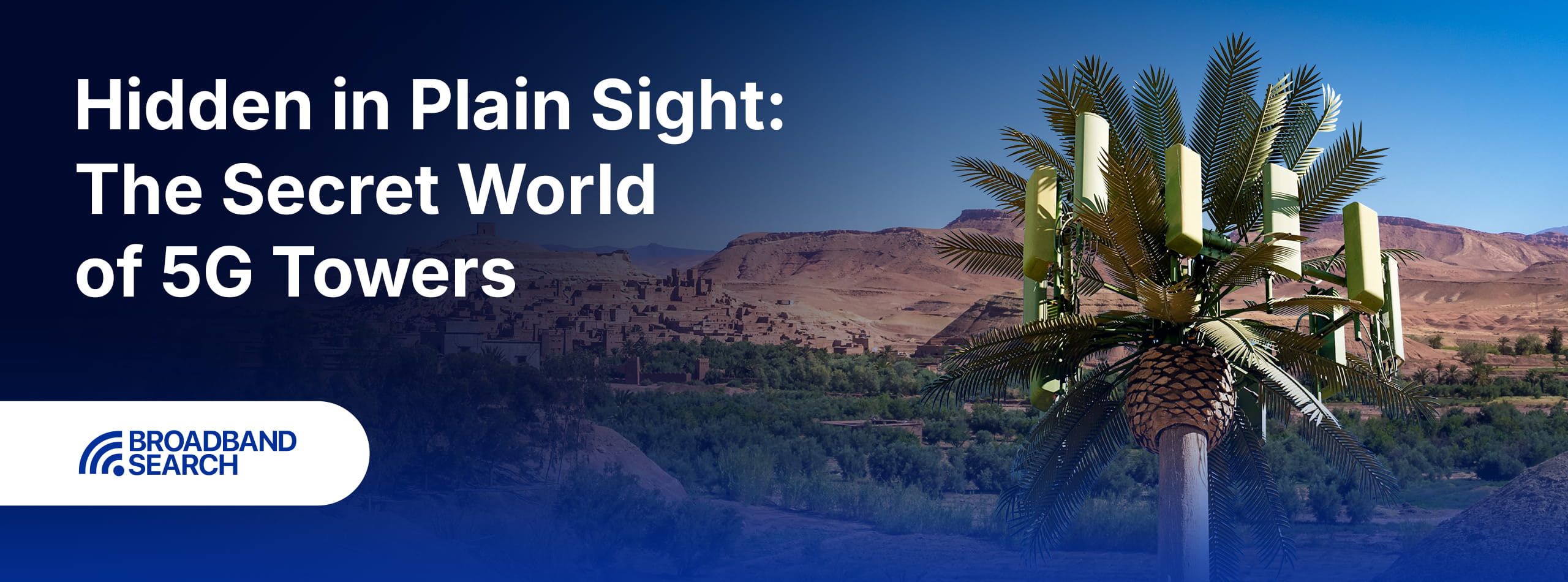
Have you ever looked twice at a particularly tall pine tree or a strangely thick flagpole? You might have spotted a "stealth cell tower." As 5G technology expands across the country, providers are finding creative ways to hide the necessary infrastructure in plain sight.
These disguised towers are becoming more common as carriers race to build the dense networks required for 5G speed. But what exactly are they, and how can you spot them?
Key Takeaways
- Disguised Design: 5G towers are often hidden inside everyday structures like trees, flagpoles, and streetlights to reduce visual clutter.
- Zoning Compliance: These "stealth sites" help carriers meet strict local zoning laws and HOA restrictions.
- Safety First: Despite myths, disguised towers must meet the same FCC safety standards as traditional cell towers.
- Better Coverage: These hidden small cells are crucial for the high-speed, short-range nature of 5G networks.
What Are 5G Tower Disguises?
A 5G tower disguise, often called a "stealth cell site" or "concealed node," is simply cellular equipment hidden inside a structure designed to look like something else and blend into the surroundings. Unlike the massive steel lattice towers we’re used to seeing along highways, these sites are built to blend into the local environment.
The goal isn't just aesthetic. 5G networks, that power cellular internet services like 5g home internet, rely on a higher density of antennas—often called 5G small cells—to deliver ultra-fast speeds. Because these antennas have a shorter range than older 4G technology, they need to be placed closer to homes and businesses. Disguising them helps integrate this critical infrastructure without disrupting the character of a neighborhood.
Why Are 5G Towers Disguised?
The push for stealth towers is driven by a mix of technology, policy, and public preference.
- Zoning Laws & HOAs: Many municipalities and Homeowners Associations (HOAs) have strict rules against visible utility structures. Stealth designs are often the only way carriers can get approval to build in residential areas.
- Visual Impact: Let's face it, traditional cell towers aren't pretty. Concealing antennas helps maintain property values and community aesthetics.
- Network Density: 5G home internet works bestwith more, smaller antennas in many areas. Hidden small cells provide extra capacity and coverage without building a full-size tower on every block.
Common Types of 5G Tower Disguises
While the classic "Frankenpine" is the most famous example, disguise technology has evolved. Here are some of the most common ways 5G is hiding in your neighborhood.
Flagpole Cell Towers
One of the most popular disguises in schools, business parks, and government buildings is the flagpole. These structures feature a hollow pole made of radio-frequency-transparent material (like fiberglass) that hides the antennas inside.
- Where to find them: Schools, stadiums, and municipal buildings.
- How they work: Cables run up the center, and the flag flies normally, making the tech nearly invisible.
Fake Trees (Monopines, Palms, Pines)
These are the most recognizable stealth towers. In the Pacific Northwest and Northeast, they look like oversized pine trees ("monopines"). In the South and West, you'll see fake palm trees ("monopalms") or even saguaro cacti.
- Why they stand out: They are often much taller than surrounding trees to ensure a clear signal path.
- The controversy: While better than bare metal, the fake branches can sometimes look unnatural or "uncanny" to locals.
Streetlights and Utility Poles
This is the most common form of 5G deployment in cities. Known as "small cells," these antennas are mounted on top of or inside existing light poles and utility lines.
- The benefit: They use existing infrastructure, reducing the need for new construction.
- Spotting them: Look for a thicker base at the bottom of the pole (housing the radio equipment) or a cylindrical canister at the very top.
Church Steeples, Crosses, and Clock Towers
Churches and historic buildings have long leased space to telecom companies. The height of a steeple or bell tower makes it a perfect broadcasting point.
- Concealment: Antennas are often hidden behind louvers (slats) in a bell tower or inside a hollow fiberglass cross.
- Community win-win: The church gets rental income, and the carrier gets a high vantage point without building a new tower.
Rooftop & Building-Mounted Disguises
In dense urban areas, you rarely see a standalone tower. Instead, panels are painted to match building facades or hidden inside structures that look like chimneys, HVAC units, or parapet walls.
- Chimneys: Both old brick chimneys and new fake ones can house cellular arrays.
- Ventilation pipes: Fake vents are a common way to hide antennas on apartment rooftops.
Water Towers and Silos
In rural areas, water towers and grain silos are natural high points. Carriers often paint antennas to match the tank perfectly or hide them inside a false top added to the structure.
- Rural Connectivity: These are critical for extending rural internet access where fiber hasn't reached yet.
How to Spot a Disguised 5G Tower
Curious if that new lamppost is actually a 5G node? Here are a few tell-tale signs:
- Unusual Bulk: Does the pole look thicker than others nearby?
- Equipment Cabinets: Is there a new metal utility box nearby with warning stickers?
- Perfect Geometry: "Tree" branches that look too symmetrical or don't move in the wind.
- Noises: A low hum from cooling fans inside the equipment housing.
- Fiber Lines: Fresh cuts in the sidewalk or new fiber optic cable markers leading to the structure often indicate a backhaul connection.
Are Disguised 5G Towers Safe?
With the rise of 5G, questions about safety are natural. It is important to know that disguised towers are subject to the same rigorous safety standards as any other cellular infrastructure.
According to the FCC, the radio frequency (RF) emissions from 5G antennas must stay within established safety limits. In fact, because small cells are typically lower power than massive macro towers, their output is often significantly lower. Both the FCC and the World Health Organization monitor this technology closely to ensure public safety.
5G Small Cells vs. Traditional Cell Towers
Feature | Traditional Tower (Macro) | 5G Small Cell (Stealth) |
Height | 50–200 feet | 20–50 feet |
Range | Miles | Hundreds of feet |
Visibility | Highly visible | Low profile / Disguised |
Power | High | Low |
Use Case | Wide area coverage | Density & high speed |
While traditional towers act as the "backbone" covering large areas, small cells fill in the gaps to provide the intense capacity needed for streaming 4K video or gaming on mobile broadband.
Do Disguised Towers Affect Internet Speed?
Does hiding an antenna behind fake bark slow down your connection? Generally, no. The materials used—like fiberglass, specialized plastics, and RF-transparent fabrics—are designed to let signals pass through freely.
In fact, the proximity of these disguised towers is a huge benefit. By bringing the signal closer to you (without being an eyesore), they improve internet latency and download speeds. This is especially relevant for users on 5G home internet plans, where line-of-sight can significantly impact performance.
What This Means for Homes and Businesses
The proliferation of stealth towers is good news for connectivity.
- Smart Homes: More nodes mean more reliable connections for IoT devices, from security cameras to smart thermostats.
- Property Value: Good cellular and internet service is a top priority for homebuyers. Stealth infrastructure provides this without the "industrial" look of old towers.
- Competition: As 5G becomes more viable, it offers a real alternative to cable and DSL, potentially helping you lower your internet bill.
Future of 5G Tower Design
As technology advances, the "Frankenpine" might become a thing of the past. Future 5G infrastructure is moving toward integrated smart city design. Imagine bus stops, interactive kiosks, and even manhole covers that double as network nodes.
We are also seeing a shift toward "neutral host" networks, where one stealth pole serves multiple carriers (AT&T, Verizon, T-Mobile) simultaneously, reducing the total number of poles needed on a street.
Have You Noticed Any 5G Towers in Your Neighborhood?
5G tower disguises are a compromise between our demand for instant, high-speed connectivity and our desire for beautiful, uncluttered neighborhoods. While some attempts—like the awkward cactus—might miss the mark, the technology is improving every day.
The next time you’re walking through town, take a closer look at that streetlight or flagpole. You might be looking at the future of the internet. For up-to-date information on all things internet, make sure to keep up with BroadbandSearch.
FAQ
What do 5G towers look like?
They vary wildly! They can look like traditional cell towers, fake trees, flagpoles, or small canisters attached to streetlights. In cities, they are often small rectangular boxes painted to blend in with buildings.
Are fake trees really cell towers?
Not all of them, but if you see a remarkably tall, symmetrical tree with slightly "off" coloring, it’s likely a monopalm or monopine housing cellular antennas.
Can you tell if a streetlight is a 5G tower?
Look for a cylindrical cap on the very top of the light or a rectangular equipment box attached to the side. These usually indicate a "small cell" installation.
Are stealth cell towers safe near homes?
Yes. All cellular infrastructure in the U.S. must comply with strict FCC guidelines regarding RF exposure. 5G small cells generally operate at lower power levels than traditional large towers.
Why does 5G need more towers than 4G?
5G signals, especially the ultra-fast mmWave bands, don't travel as far as 4G signals. To maintain speed and reliability, some deployments need a denser network of smaller towers rather than a few large ones.