
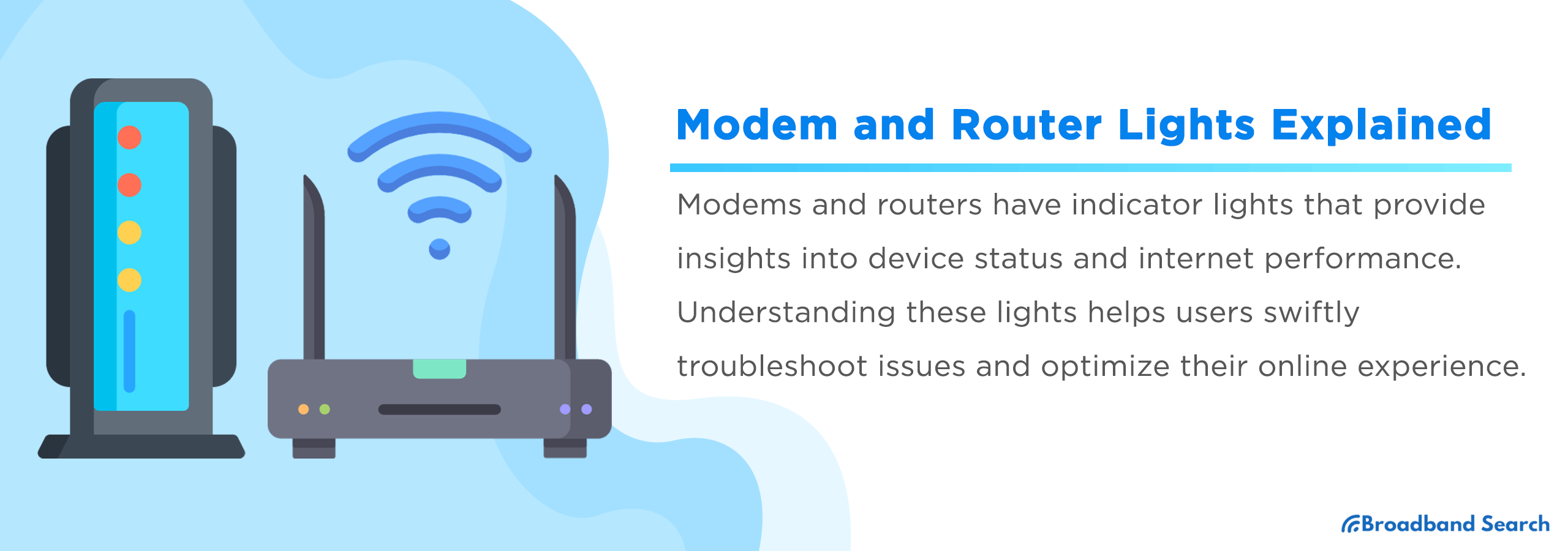
Your modem and router are communicating with you constantly — through a panel of LEDs that most people ignore until something goes wrong. Learning to read those lights is the fastest way to diagnose a connection problem, determine whether the issue is inside your home or upstream with your provider, and decide whether you need to call for help or just unplug something for 60 seconds. This guide covers what every light means, what normal looks like, and exactly what to do when it doesn't.
What Your Modem Lights Are Telling You: Quick Answer
Green or white lights on a modem or router generally indicate normal operation. Orange, amber, or red lights typically signal a partial connection, hardware error, or lost signal — though the exact meaning varies by manufacturer and provider. If your online or internet indicator light is off or flashing, your modem hasn't established an active connection with your ISP. Most light-based issues resolve with a 60-second power cycle — unplug both your modem and router, wait a full minute, then plug the modem back in first before the router.
Important note: light colors, patterns, and meanings vary significantly between manufacturers, providers, and device generations. This guide covers the most common patterns, but always check your specific device's manual or your provider's support page for exact definitions.
Key Takeaways: What Your Modem Is Telling You
- Color patterns are generalizations, not universal rules: Green and white typically signal normal operation. Red and orange typically signal a problem. But these meanings shift by brand and provider — always verify against your device's documentation.
- Solid vs. blinking tells you the state: Solid lights indicate a locked, stable status. Blinking lights indicate active searching, data transmission, or an in-progress process. Whether blinking is good or bad depends entirely on which light is doing it.
- The online or internet light is your most important LED: If this light isn't solid, your modem hasn't established an active feed from your ISP — everything else on your network is irrelevant until that one is solid.
- WPS is a security consideration: A blinking blue or purple light often means WPS (Wi-Fi Protected Setup) is active — a feature that lets new devices pair quickly without a password. While convenient, an active WPS session is a known security vulnerability. Disable WPS in your router's admin settings when not actively pairing a device.
- Power cycle first: According to the FCC, most common connection issues resolve when you unplug your modem and router for 60 seconds and let them reconnect cleanly.
Quick Reference: What Do Modem Light Colors Mean?
These are the most common color and pattern meanings across major consumer modems and routers. They are generalizations — your specific device may use different colors or patterns for the same states. When in doubt, check your device manual or provider's support documentation.
Light Color / Pattern | What It Usually Means | Normal? |
Solid green or white | Connected and operating normally | Yes |
Blinking green or white | Establishing a connection or actively transferring data | Depends on which light — see sections below |
Solid blue | High-speed connection active (cable: DOCSIS 3.1 bond); or successful WPS pairing | Yes — cable-specific for DOCSIS |
Solid or blinking orange / amber | Partial connection, weak signal, or firmware update in progress | No — investigate |
Solid red | Hardware error, power failure, or no broadband signal detected | No — action required |
Blinking red | Modem searching for signal, overheating warning, or critical error | No — action required |
Blinking blue or purple | WPS pairing mode active | Temporary — disable when done |
No light | Device is off or power adapter has failed | No — check power source |
Modem Light Meanings by Major Provider and Brand
The table below covers the most common status light patterns for major providers and router brands as of 2026. Light behavior is subject to change with firmware updates — link to each provider's documentation for the most current reference.
Brand / Provider | Normal Status Light | Warning or Error | What to Do | Reference |
Solid white | Blinking amber or red | Check coaxial cable connection at wall and device | Xfinity status light guide | |
Spectrum | Solid blue | Blinking blue and white | Modem searching for signal — wait for it to complete or reboot | |
Solid green | Blinking or solid red | ONT signal failure — check fiber cable or call support | ||
Netgear | Solid white or green | Solid amber | Firmware update in progress or connection gap — do not unplug | |
ASUS | Solid white | Blinking red | No WAN connection — check Ethernet cable from modem to router | |
Eero | Solid white | Solid red | No internet connection — reboot modem first, then eero |
Why Is My Modem Flashing Green?
A flashing green light on your modem is usually normal during startup — but it becomes a problem if it never stops.
Normal Startup Behavior
During the first 3–5 minutes after a reboot, a flashing green light on the online, downstream, or upstream indicators is expected. Your modem is scanning for available frequencies, locking onto channels, and completing the connection handshake — the technical negotiation process between your modem and your ISP's Cable Modem Termination System (CMTS) that establishes your broadband session. This is cable-specific behavior. Fiber ONTs and 5G gateways go through a similar initialization process but may display different colors during startup.
When Flashing Green Becomes a Problem
If the online or internet light continues flashing for more than 10 minutes after a reboot, your modem is stuck in a connection loop — it's searching for a signal it can't find or can't lock onto. Common causes include a loose or damaged coaxial cable at the wall jack or the back of the modem, a splitter on the line that's degrading signal quality, an outage in your area, or a provisioning issue with your ISP account. Try bypassing any splitters by connecting your modem directly to the wall jack. If the light stabilizes, the splitter is degrading the signal. If it doesn't, check your provider's outage map or call support.
Understanding US/DS Lights and Orange or Amber Indicators
US/DS Lights — Upstream and Downstream
US/DS lights (Upstream/Downstream) indicate whether your modem has successfully locked onto the data channels it uses to send and receive information. These lights are specific to cable modems — fiber and 5G equipment handle channel bonding differently and may not have US/DS indicators.
Under normal operation, US/DS lights should be solid. Blinking US/DS lights mean the modem is actively searching for or trying to lock onto channels — it hasn't established a stable connection yet. If they blink indefinitely, the modem can't complete channel bonding, usually due to signal quality issues on the line.
Orange and Amber Lights
Amber / Orange Pattern | Likely Meaning | What to Do |
Solid amber on US/DS | Partial channel bonding — fewer channels locked than your plan requires | Check cable connections; call ISP if it persists |
Pulsing amber on power or status light | Firmware update in progress | Do not unplug — wait for it to complete |
Solid amber on WAN or internet light | Router connected to modem but no active internet signal | Verify modem's online light first; reboot sequence if needed |
Amber after a speed test shows slower speeds | Possible line noise reducing signal quality | Request a line signal test from your ISP |
Never unplug a modem or router while it's pulsing amber — if a firmware update is interrupted mid-process, it can corrupt the device's software and render it unusable. Wait for the amber to resolve before powering anything down.
What Lights Should Be On My Router for Normal Internet?
Your router manages two separate functions — the WAN side (connection to your modem) and the LAN side (connection to your devices). Each has its own indicator lights, and reading them separately is important for diagnosing where a problem actually is.
Power LED
The power light should be solid at all times during normal operation. A flickering power light that isn't part of a startup cycle suggests a failing power adapter. Try a different outlet first, then replace the power brick if the flickering continues. A completely dark power light means the router isn't receiving power — check the outlet, the power adapter connection at the router, and whether the adapter brick itself feels warm (indicating it's working) or cold (indicating failure).
WAN or Internet Light
This light indicates whether your router has successfully established a connection with your modem. It should be solid green or white during normal operation. A red WAN light typically means one of three things: the Ethernet cable between your modem and router is faulty or disconnected, your modem hasn't fully come online yet, or your router hasn't received a valid IP address from the modem. Try swapping the Ethernet cable between modem and router first — this resolves the issue more often than expected. If the WAN light stays red after a cable swap and a full reboot sequence, the problem is likely with the modem's connection to your ISP rather than the router itself.
LAN Port Lights
LAN port lights indicate activity on wired connections between your router and connected devices. A solid light on a LAN port means a device is connected but not actively transferring data. A flickering light means data is actively moving — this is normal and healthy. No light on a port where a device should be connected means the cable is disconnected, the port on the device is disabled, or the cable is faulty.
Wi-Fi Activity Light
The Wi-Fi indicator light is separate from the data/link lights on most routers. Rapid flickering on the Wi-Fi indicator is normal — it means wireless devices are actively communicating with the router. A solid Wi-Fi light with no flickering can mean Wi-Fi is enabled but no wireless devices are currently active. A Wi-Fi light that's completely off means wireless broadcasting is disabled — check your router's admin panel or physical Wi-Fi on/off button if your router has one.
WPS Light
A blinking blue or purple WPS light means your router is in pairing mode — actively looking for a new device to add to the network without requiring a password. WPS was designed for convenience but has known security vulnerabilities: while WPS is active, your network is more susceptible to unauthorized pairing attempts. Disable WPS in your router's admin panel under the wireless or security settings when you're not actively using it. Most consumer routers allow you to turn off WPS permanently, which is the recommended setting for security-conscious households.
Fiber ONT Light Meanings
If you have fiber internet, your main connection device is an ONT (Optical Network Terminal) rather than a traditional modem. ONT lights work differently from cable modem lights.
ONT Light | Normal State | Problem State | What It Means |
Power | Solid green or white | Off | ONT not receiving power — check power adapter |
Solid green | Red or blinking | Fiber signal issue — cable may be damaged or disconnected | |
Data or Link | Blinking | Off or solid red | Reflects active communication between the ONT and your provider's network — blinking is normal activity |
LOS (Loss of Signal) | Off | Solid red | Fiber line has lost signal — physical cable issue or provider outage |
Alarm or Fail | Off | Any light | Critical hardware failure — technician visit typically required |
The PON or optical light is your most important ONT indicator — it tells you whether the fiber cable itself is delivering a signal from your provider's network. A red or blinking PON light almost always indicates a physical issue with the fiber cable: a bend, a break, a disconnected connector, or debris on the optical connector face. Do not attempt to repair or reconnect fiber cable yourself — the connectors require specialized cleaning tools and alignment equipment. If the PON light is red and a reboot doesn't resolve it, contact your fiber provider for a technician visit.
Using Your Provider's Companion App
Most major ISPs and router manufacturers offer companion apps that give you a real-time view of your equipment status, connected devices, and network health — without logging into a router admin panel.
Provider / Brand | App Name | What It Shows |
Xfinity | Xfinity app | Gateway status, connected devices, restart remotely |
AT&T | Device status, speed tests, parental controls | |
Spectrum | My Spectrum | Equipment status, outage alerts, reboot remotely |
Eero | Eero app | Network health, device activity, speed tests |
Netgear | Nighthawk app | Router status, traffic monitoring, firmware updates |
ASUS | ASUS Router app | Real-time traffic, connected devices, security alerts |
These apps are particularly useful for checking whether a light-based issue is isolated to your home or part of a broader provider outage — many push outage notifications directly to your phone before you've even noticed your connection is down. Download your provider's app and enable push notifications before you need them.
How to Troubleshoot Your Modem Using Light Patterns
Work through these steps in order. Each one rules out a cause before moving to the next.
- Check the power light. If it's off or flickering, test the outlet with another device. Try a different outlet or power strip. If the router still won't power on, the power adapter may have failed — replace it before assuming the router itself is broken.
- Check the online or internet light. If the power light is solid but the online light is off or flashing, the problem is between your modem and your ISP — not your router or Wi-Fi. Run your provider's outage checker using cellular data before rebooting, so you know whether to wait or act.
- Power cycle your equipment. Unplug your modem first, then your router. Wait a full 60 seconds — this clears the internal memory cache and forces a fresh connection request. Plug the modem back in first and wait for its online light to go solid (2–5 minutes) before plugging in the router. Skipping the wait is the most common reason a power cycle doesn't work.
- Inspect physical connections. Check the coaxial or fiber cable at both the wall jack and the back of the modem — these work loose over time and are a surprisingly common cause of signal issues. For routers, check the Ethernet cable between modem and router. Try replacing it if you have a spare.
- Check your provider's companion app. Open your ISP's app or status page using cellular data to troubleshoot for active outages or equipment alerts tied to your account address. Many issues that look like hardware failures are actually provider-side.
- Factory reset — as a last resort only. A factory reset erases all custom settings and returns the device to its default configuration. On most consumer devices, press and hold the reset button for 10–15 seconds using a pin or paperclip. Do not hold it longer than directed in your manual — extended holds on some models can corrupt firmware. Only perform a factory reset if instructed by your manufacturer's support documentation or an ISP technician, and be prepared to reconfigure your Wi-Fi network name, password, and any custom settings afterward.
Conclusion: Read the Lights, Then Decide
Your modem and router lights are the fastest diagnostic tool you have — they tell you within seconds whether the problem is in your home, in your equipment, or upstream with your provider. A solid online light means your ISP feed is active and the problem is somewhere between your modem and your devices. An offline or flashing online light means the problem is between your modem and your ISP connection — and no amount of router configuration or Wi-Fi troubleshooting will fix it until that light goes solid.
Start with a power cycle. Check your companion app for outage alerts. Inspect your cables. Work through the steps in order, and use the light patterns in this guide to tell you which direction to look. Most issues resolve before you ever need to call anyone.
If you've cycled the power, checked your cables, confirmed there's no outage in your area, and the online light still won't hold — your hardware or your ISP connection needs professional attention. Before replacing anything, find out if the issue is on your street, not just in your home. And once you're back online, run a speed and latency test to confirm your connection is delivering what your plan promises — because a stable light doesn't always mean full performance.
FAQ
What Does a Red Light on My Router Mean?
A red light on a router most commonly means it cannot establish a connection with the modem or that your internet service has been interrupted upstream. Start by checking the Ethernet cable between your modem and router — swap it for a known working cable if possible, since a damaged cable is a more common culprit than most people expect. If the cable is fine, check whether your modem's online or internet light is solid. If the modem is also showing an error, the problem is with your ISP connection rather than your router. A red light specifically on a WAN or internet port that persists after a full reboot and cable check usually means calling your provider is the right next step.
Why Is My Internet Down But My Modem Lights Are Green?
Green lights on a modem confirm the device has established a connection with your ISP — but they don't guarantee every part of your network is working. The most common cause of this specific scenario is a DNS (Domain Name System) failure. DNS is the service that translates website names into the IP addresses your devices actually route to — if DNS fails, your connection is technically active but websites won't load because addresses can't be resolved. Try manually switching your DNS server: on your router's admin page, set the primary DNS to 8.8.8.8 (Google) or 1.1.1.1 (Cloudflare) and the secondary to 8.8.4.4 or 1.0.0.1. Another possibility is that your router received an incorrect or expired IP address from the modem — a full reboot sequence usually resolves this. If the problem persists after a reboot and a DNS change, connect a device directly to the modem via Ethernet to isolate whether the issue is in the router or the ISP feed.
Should the US/DS Lights Be Blinking?
No — under normal operation, US/DS (Upstream/Downstream) lights should be solid. These lights are specific to cable modems and indicate whether the modem has successfully locked onto the upstream and downstream channels it uses to communicate with your ISP. Blinking US/DS lights mean the modem is still searching for or attempting to lock onto channels — it hasn't completed a stable connection. If they blink for more than 10 minutes after a reboot, check the coaxial cable at the wall jack and the back of the modem, bypass any splitters on the line, and contact your ISP to check the signal levels coming into your home. A technician can run a remote signal test and identify whether the issue is in your home wiring or on the provider's side. Different connection types have different troubleshooting steps.
How Do I Know if My Modem Is Overheating?
A modem that is overheating will typically display orange or red lights in combination with a chassis that feels hot to the touch — noticeably hotter than warm. Some devices go into thermal throttling when they overheat — a CPU-level protective measure that reduces processing speed to lower heat output, resulting in slower speeds even when lights appear normal. Modems should be placed in open air, not enclosed in cabinets or on carpet. Keep at least two inches of clearance on all sides. If overheating is recurring, check that the ventilation slots on the device aren't blocked by dust — a gentle blast of compressed air through the vents can help. Persistent overheating in a device that's more than four or five years old is often a sign the hardware is nearing end of life.
Can a Bad Ethernet Cable Cause Connection Problems?
Yes — and more often than most people expect. A damaged or low-quality Ethernet cable between your modem and router can prevent the router from negotiating a gigabit connection, forcing both devices to fall back to a 10/100 Mbps connection. This shows up as slower-than-expected speeds even when every light appears green. Some routers display an amber WAN light specifically to indicate a 10/100 fallback rather than a full gigabit link. If you're troubleshooting unexplained speed drops and your lights look normal, swapping the Ethernet cable between modem and router is a low-cost, high-return first step before any further investigation into wired vs. Wi-Fi performance.
Why Do My Modem Lights Keep Going On and Off at Night?
cheduled ISP maintenance and automatic firmware updates are the most common cause of nighttime light activity. Providers typically perform network maintenance and push firmware updates during low-traffic hours — between midnight and 5 AM — to minimize impact on active users. Your modem may reboot automatically when a firmware update is applied, causing lights to cycle through their startup sequence briefly before returning to normal. If the cycling is brief (under 10 minutes) and service is normal in the morning, this is expected behavior. If lights are cycling repeatedly through the night and you have no internet in the morning, check your provider's status page for maintenance notices or call support to check for signal issues on your line.
Why Is My Online Light Solid But I Still Have No Internet?
A solid online light confirms your modem has an active connection to your ISP — but the problem may be between your modem and your router, or between your router and your devices. Start by connecting a device directly to the modem using an Ethernet cable. If internet works on that device, the modem is fine and the issue is in your router — reboot it and check the WAN cable. If direct-to-modem also fails, the modem has a connection to the ISP but isn't passing data correctly — this can indicate a provisioning issue, an IP address lease problem, or an account-level block. A call to your ISP with the modem's MAC address on hand will help them diagnose this quickly. If you're still having internet issues, you may need to troubleshoot further.