
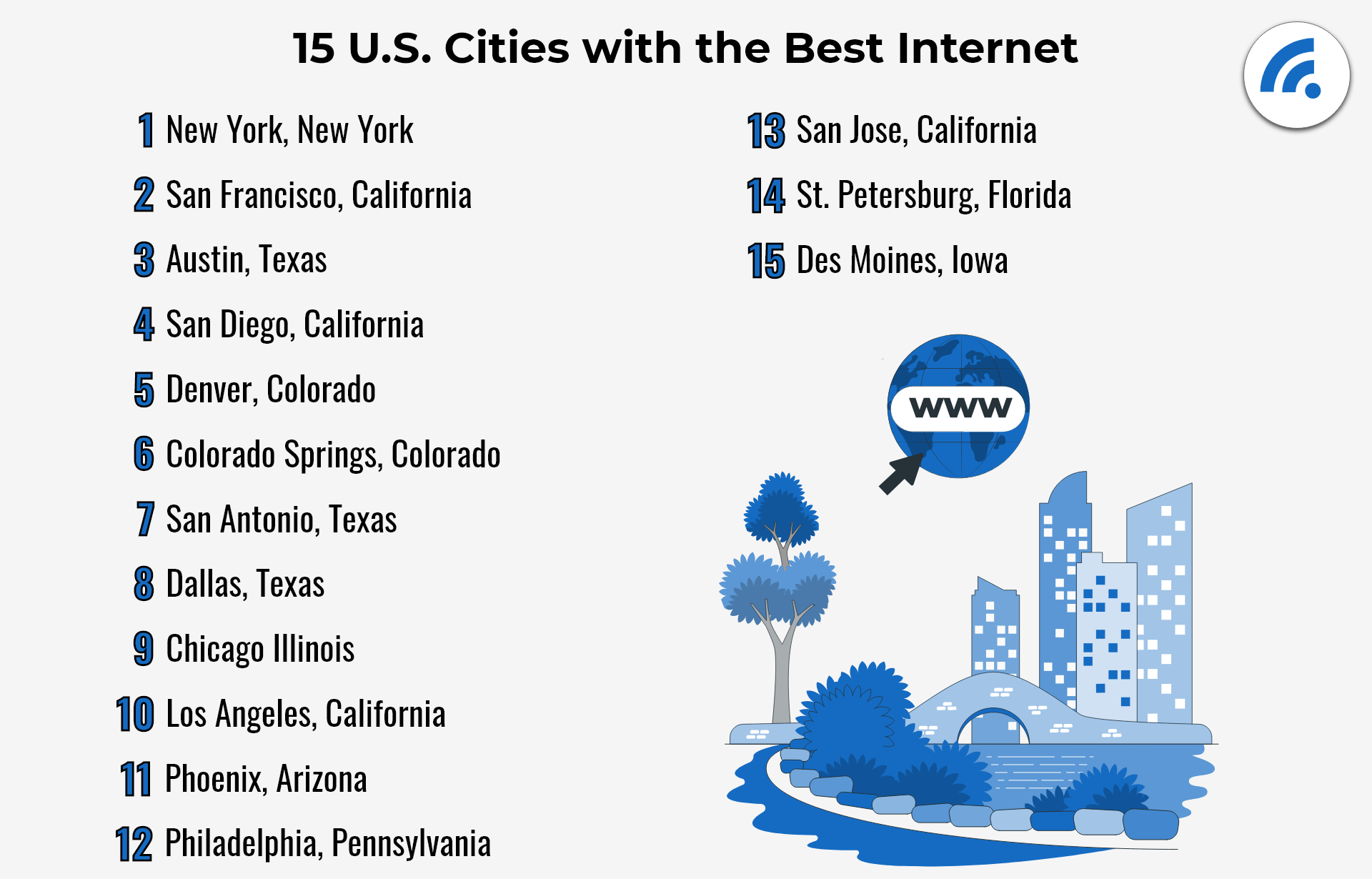
In 2026, U.S. average internet speeds nationwide have improved, but certain cities lead the charge with high-speed, reliable service thanks to robust fiber-optic infrastructure and fierce ISP competition. Metropolitan areas benefit from providers rolling out multi-gigabit (2 Gbps+) plans, setting a standard for high performance and low latency.
You can compare all local options to determine which provider offers the best speeds at your home address.
Key Takeaways: U.S. Cities with the Best Internet
- The average U.S. home internet download speed is approximately 298 Mbps as of October 2025.
- The cities with the fastest internet often feature access to multi-gig options and widespread gigabit fiber connections.
- Our extensive list highlights major and mid-sized cities that attract professionals, making it ideal for those considering relocation for work opportunities.
- High-speed, stable connections in these areas are particularly beneficial for demanding users such as remote workers, online gamers, and streamers.
- The actual speed you receive depends heavily on your location. You should always verify internet options for their exact address or ZIP code before deciding where to live or move.
How We Chose the U.S. Cities with the Best Internet
Our city rankings for the fastest internet in 2026 are based entirely on verified data from leading analytics firms and government sources, not just provider promises. We analyze metrics from millions of consumer speed tests and official infrastructure maps to create a realistic picture of the actual internet experience in those markets.
What Data We Used
- Speed Test Intelligence Reports: We use anonymous data from millions of speed tests run by real people at home. It helps us find the actual average internet speeds users experience every day, using reports from companies like Ookla.
- Provider and Infrastructure Reports: Industry reports and services like ISP Reports provide information on the types of internet available, such as fiber versus cable, and the level of competition among providers in that city.
Please note that the data points used for these rankings reflect snapshots from 2023 through 2025. The broadband market evolves rapidly, and speeds may improve as new fiber networks are built out and activated.
- Federal Communications Commission (FCC) and Broadband Maps: We cross-reference commercial data with official government sources, including the FCC Broadband Data Collection (BDC) maps, to verify the physical availability of broadband (at least 100 Mbps download and 20 Mbps upload per the FCC) services at the census block level.
- Reputable Comparison Sites: We aggregate information from trusted comparison and availability sites that continuously track provider offerings, pricing, and plan speeds.
Criteria for "Best Internet"
When determining which cities have the best internet service in 2026, we rely on specific, data-driven criteria that define a high-quality online experience:
- Average Download and Upload Speeds: We prioritize cities with high median speeds, as experienced by average users, and give special consideration to symmetrical upload and download speeds offered by fiber providers.
- Availability of Gigabit+ Service: A key metric is the percentage of homes that have access to gigabit (1,000 Mbps) or faster internet plans.
- Diverse Mix of ISPs: Top-ranking cities benefit from healthy competition and a mix of available technologies, including strong fiber infrastructure, robust cable options, and modern 5G home internet, ensuring consumer choice.
- Latency and Reliability: We look at data points for low latency, which is crucial for lag-free video calls, gaming, and responsive web browsing.
- Remote-Work Friendliness (Bonus): Extra factors like available shared office spaces (coworking), public Wi-Fi spots, and good 5G phone coverage beneficial for people who work remotely.
At a glance: 15 U.S. cities with the best internet (2026)
Here is a table summarizing the U.S. cities we identified as having the best internet services based on data collected via speedtest.net.
City, StateAvailable Download Tiers (Mbps)Gigabit+ AvailabilityMain Connection TypesExample Top ISPsNew York, NY288 – 8,000 MbpsHigh multi-gig availabilityFiber, Cable, 5G Home InternetVerizon Fios, Optimum, SpectrumSan Francisco, CA266 – 10,000 MbpsWidespread multi-gig accessFiber, Cable, 5G Home InternetAT&T, Xfinity, SonicAustin, TX300 – 5,000 MbpsWidespread gigabit accessFiber, CableAT&T, Google Fiber, SpectrumSan Diego, CA150 – 5,000 MbpsHigh multi-gig availabilityFiber, Cable, 5G Home Internet, Fixed WirelessAT&T, Cox, Spectrum, VerizonDenver, CO150 – 8,000 MbpsWidespread gigabit+Fiber, Cable, 5G Home Internet, Fixed WirelessQuantum Fiber, Xfinity, AT&T, T-MobileColorado Springs, CO300 – 8,000 MbpsHigh multi-gig availabilityFiber, CableQuantum Fiber, XfinitySan Antonio, TX300 – 5,000 MbpsWidespread gigabit accessFiber, CableAT&T, SpectrumDallas, TX200 – 7,000+ MbpsHigh multi-gig availabilityFiber, Cable, 5G Home Internet, Fixed WirelessAT&T, Frontier, Spectrum, AstoundChicago, IL200 – 5,000 MbpsWidespread cable, growing fiberFiber, Cable, 5G Home InternetAT&T Fiber, Xfinity, AstoundLos Angeles, CA200 – 10,000 MbpsWidespread gigabit+Fiber, Cable, 5G Home Internet, Fixed WirelessAT&T Fiber, Spectrum, FrontierPhoenix, AZ200 – 8,000 MbpsHigh multi-gig availabilityFiber, Cable, 5G Home Internet, Fixed WirelessQuantum Fiber, Cox, AT&TPhiladelphia, PA150 – 3,000+ MbpsWidespread cable, growing fiberFiber, Cable, 5G Home InternetXfinity, Verizon Fios, T-MobileSan Jose, CA250 – 10,000 MbpsWidespread gigabit+ accessFiber, Cable, 5G Home Internet, Fixed WirelessAT&T, Xfinity, SonicSt. Petersburg, FL200 – 7,000 MbpsWidespread gigabit+Fiber, Cable, 5G Home InternetFrontier, Spectrum, WOW!, AT&TDes Moines, IA200 – 8,000 MbpsWidespread gigabit+Fiber, Cable, 5G Home Internet, Fixed WirelessQuantum Fiber, Metronet, Mediacom Enter your ZIP code to compare providers, speeds, and pricing where you live.
New York, New York — Dense Fiber Coverage and Multi-Gig Metro Speeds
New York City is a top choice for internet speed and provider options due to its extensive fiber-optic network and the availability of multiple service providers.
Approximately 89% of residents have access to fiber internet in NYC from providers like Verizon Fios and Optimum, supporting multi-gig speeds. Most residents can choose from various connection types, including fiber, cable, and 5G home internet services.
New York City has a higher-than-average download speed of 300 Mbps and frequently appears in top-speed rankings across its boroughs.
Best for:
- NYC remote workers need dependable home internet service with backup options. The city offers fiber, cable, and fixed wireless.
- Some rely heavily on NYC's extensive public Wi-Fi and coffee-shop networks instead of home service.
San Francisco, California — A-Grade Connectivity in a Tech Hub
San Francisco features strong fiber adoption and advanced network infrastructure, earning it an A- connectivity grade. The city has committed to expanding high-speed internet to bridge the digital divide for all residents.
Over 56% of San Francisco residents have access to fiber internet. Providers such as AT&T Fiber and Sonic are major players in the fiber expansion, offering multi-gigabit speeds in many neighborhoods.
Most residents have a choice among multiple internet service providers in San Francisco, including fiber, cable (e.g., Xfinity), and 5G fixed wireless.
While the city's median download speed is around 266 Mbps, many areas have access to multi-gigabit plans, with some internet providers in San Francisco offering speeds up to 10 Gbps (Sonic) in select locations.
Best for:
- San Francisco remote workers prioritize high-speed fiber for easy cloud access and symmetrical upload speeds.
- Tech-savvy households benefit from a high density of providers offering competitive multi-gig speeds.
Austin, Texas — Competitive Multi-Gig Fiber for Remote Workers
Austin, Texas, has established itself as a fiber powerhouse and a magnet for remote workers and tech companies, offering highly competitive multi-gig fiber internet plans.
Austin has extensive fiber coverage from major providers, including EarthLink, which offers plans up to 5 Gbps.
While the typical median fixed broadband download speed in Austin, Texas, is 381 Mbps, the wide availability of gigabit and multi-gig options means residents can easily upgrade to top-tier service.
In addition to fiber, Austin, Texas, residents have access to cable services (like Spectrum), fixed wireless, and 5G home internet (like EarthLink), ensuring a competitive market.
Best for:
- Remote workers and creative professionals in Austin, TX, who need reliable, high-speed symmetrical uploads for large file transfers and cloud collaboration.
- Gamers who benefit from the low latency and consistent speeds offered by fiber connections.
San Diego, California — a Coastal City with Solid Gigabit Options
San Diego offers a balance of a coastal lifestyle and reliable, fast home internet, with solid gigabit and multi-gig options available in much of the city. While the median download speed is around 327 Mbps, San Diego residents have access to some of the fastest fiber plans on the market.
Urban areas in San Diego County have widespread access to fixed broadband options (around 94% coverage), although availability is more limited in the rural and unincorporated eastern parts of the county.
Major internet providers in San Diego include AT&T, Spectrum, and 5G home internet options from EarthLink. Google Fiber Webpass is also an option in select multi-dwelling units in the urban core.
Gigabit speeds in San Diego are widely available via both fiber and cable networks. Multi-gig plans are available from providers like EarthLink Fiber (up to 5 Gbps) and Spectrum (up to 2 Gbps in select areas).
Best for:
- People who enjoy the San Diego climate and a strong, reliable home internet connection to support remote work, streaming, and gaming.
- Residents in urban San Diego, CA, benefit from competitive fiber options and multi-gig speeds.
Denver, Colorado — a High-Altitude City with Strong Gigabit Competition
Denver, Colorado, balances Rocky Mountain living with a competitive broadband landscape, offering residents strong gigabit options from multiple providers. The city's competitive market keeps speeds robust and pricing aggressive.
Major internet providers in Denver include Xfinity, CenturyLink, and Quantum, which offer a mix of cable and fiber connections. Fixed wireless 5G options from EarthLink are also available.
Gigabit speeds are widespread across most Denver neighborhoods, with multi-gig fiber options available in many urban and suburban developments.
Best for:
- Denver offers a blend of outdoor access (Rockies) and reliable, high-speed internet for work and play.
- Remote workers and families benefit from multiple fiber and cable options.
Colorado Springs, Colorado — Emerging Multi-Gig Hotspot
Colorado Springs, Colorado, is quickly emerging as a rising star for multi-gig fiber internet access, transforming from a city with limited options to one with widespread high-speed availability.
Colorado Springs is seeing a significant expansion of multi-gigabit options, with some providers, like Quantum Fiber, offering symmetrical speeds up to 8 Gbps in select locations.
Over 90% of Colorado Springs residents now have access to gigabit-speed internet or faster, a substantial improvement from past availability.
Key internet providers in Colorado Springs include Quantum Fiber and CenturyLink (fiber), Xfinity (cable), and various 5G fixed wireless options.
Best for:
- Enjoy the Colorado lifestyle near the mountains with lower costs than Denver, all without sacrificing internet quality.
- Denver residents can access the leading 8 Gbps residential fiber service for the highest data demands.
San Antonio, Texas — Fast but Affordable Big-City Internet
San Antonio offers a compelling combination of fast internet speeds and a relatively affordable cost of living compared to other major Texas cities like Austin and Dallas.
San Antonio internet providers provide excellent value, balancing good, typical download speeds (median around 393 Mbps) with accessible pricing.
Residents have a wide array of internet provider options in San Antonio, including competitive satellite internet from Viasat and HughesNet, cable service from Spectrum, and 5G home internet from EarthLink.
The robust fiber infrastructure ensures that gigabit internet in San Antonio and multi-gig options are widely available across the metropolitan area.
Best For:
- San Antonio households find high-speed internet that offers a strong balance of value without a premium price tag.
- Families and professionals enjoy big-city amenities and fast internet while benefiting from a lower cost of living compared to Austin or Dallas.
Dallas, Texas — Big-City Speeds with Plenty of Providers
Dallas, Texas, is a sprawling metro area that benefits from intense ISP competition, resulting in widespread availability of high-speed internet options, including extensive fiber coverage.
The strong competition among internet providers in Dallas ensures that residents have access to a variety of plans and speeds.
Typical median download speeds hover around 216 Mbps, but gigabit and multi-gigabit options are widely available across the metroplex, catering to the city's significant business and tech presence.
Major providers include Windstream (fiber), HughesNet (satellite), and Spectrum (cable).
Best for:
- Dallas offers extensive big-city amenities paired with strong, reliable broadband.
- Local tech workers benefit from redundant fiber options offering high upload speeds.
Chicago, Illinois — a Central U.S. Hub with Solid Gigabit Options
Chicago stands as a central Midwestern hub offering robust connectivity and solid gigabit options across its diverse neighborhoods.
Chicago's median download speed of 214 Mbps is strong, with widespread availability of gigabit speeds via fiber and cable networks. Multi-gig options are also expanding throughout the city.
Internet infrastructure in Chicago can vary significantly between the urban core and surrounding neighborhoods, with highly competitive fiber access in newer developments and established cable in residential areas.
Residents in Chicago have a choice of internet providers, including Xfinity (cable), AT&T, RCN Astound, and 5G home internet from EarthLink.
Best for:
- A strong need for reliable, high-speed connections in the Central Time Zone that support seamless team collaboration.
- Students who need strong bandwidth for online learning, research, and streaming.
Los Angeles, California — Sprawling Metro with Broad Gigabit Coverage
Los Angeles is a sprawling metropolitan area with broad gigabit coverage, though internet service quality can vary significantly by neighborhood. Despite the uneven landscape, residents generally have good options for high-speed internet.
Key internet providers in LA offer a mix of connection types, including fiber from Sonic and Frontier, cable from Spectrum and Cox, and 5G home internet from EarthLink.
Gigabit speeds in LA are available in many parts of the city via cable and fiber connections. Los Angeles fiber providers like AT&T and Frontier also offer multi-gigabit options in certain areas, with symmetrical speeds up to 1 Gbps.
Checking building or ZIP code availability is crucial, as service options in LA and internet speeds can vary significantly by location. While Spectrum's cable internet covers a large portion of the city, fiber access is more concentrated in certain pockets.
Best for:
- LA content creators, streamers, and remote workers benefit from fiber's symmetrical uploads for large files and live broadcasts.
- Individuals whose work relies heavily on cloud tools can find competitive high-speed options in their specific LA neighborhoods.
Phoenix, Arizona — a desert city with competitive gigabit plans
Phoenix is benefiting from extensive modern broadband rollouts, offering residents competitive gigabit and multi-gigabit internet plans. The rapid population growth has driven significant investment in new fiber infrastructure across the metro area.
Typical download speeds in Phoenix are robust, with gigabit and multi-gigabit fiber plans widely available from multiple providers.
Key internet providers in Phoenix include EarthLink 5G Home Internet and Cox Communications, offering extensive networks. CenturyLink also provides a multitude of services.
Phoenix generally offers a lower cost of living compared to coastal metropolitan areas like San Diego and Los Angeles, providing excellent value for high-speed internet services.
Best for:
- Remote workers and families who are seeking sunshine, more living space, and solid, affordable high-speed internet connections.
- Individuals looking for competitive fiber options in Phoenix in new developments and expanding suburban areas.
Philadelphia, Pennsylvania — strong options, but neighborhood choice matters
Philadelphia offers strong internet options, including gigabit speeds, though the service quality varies significantly across neighborhoods. Internet providers in Philadelphia offer competitive plans, but rankings for speed and affordability can differ by location.
Typical download speeds vary, but gigabit plans are available across many parts of Philadelphia via fiber and cable networks. The availability of cutting-edge fiber service versus older cable infrastructure underscores the need for residents to conduct ZIP-level research before moving or signing up for a plan.
Key internet providers in Philadelphia include Xfinity (cable, the dominant player), and Verizon Fios (fiber, available in many areas).
Best for:
- Enjoy the Northeast big-city life by carefully shopping for neighborhoods and internet plans to ensure optimal connectivity.
- Philadelphia residents who can access Verizon Fios at their specific location benefit from highly reliable, high-speed connections.
San Jose, California — Silicon Valley speeds and fiber access
San Jose, located in the heart of Silicon Valley, boasts a strong fiber presence and robust tech infrastructure, providing residents with an excellent selection of high-speed internet options and multi-gigabit offerings.
Nearly 90% of the population have access to speeds of 1 Gbps or more. The median download speed in San Jose is around 267 Mbps, ranking it well nationally.
The primary internet options in San Jose are EarthLink Fiber and Spectrum, which cover large portions of the city. Other options include Sonic fiber in select areas, and satellite internet from Viasat.
San Jose's strong tech presence means a high demand for reliable, fast internet to support remote work and multi-device households.
Best For:
- Tech workers and professionals who rely on seamless, high-speed connectivity for demanding work-from-home tasks.
- San Jose multi-device households, heavy uploaders, and streamers benefit from fiber's symmetrical speeds and low latency.
St. Petersburg, Florida — Florida standout for gigabit competition
St. Petersburg is a standout among Florida's coastal cities for its strong broadband competition and widespread access to gigabit and multi-gig fiber options. Residents of St. Petersburg have a competitive market with multiple providers offering high-speed plans, keeping options diverse.
While the city's median download speed is around 353 Mbps, many areas have access to gigabit speeds or faster. Fiber internet providers in St. Petersburg, like Frontier, offer speeds up to 1 Gbps, and cable providers like Spectrum offer speeds up to 2 Gbps.
As with many cities, specific availability in St. Petersburg can vary by neighborhood; checking your exact address is recommended to find the best options.
Best For:
- Retirees, remote workers, and families can enjoy a warm climate paired with a reliable, high-speed home internet connection.
- St. Petersburg residents benefit from competitive pricing and symmetrical fiber upload speeds for file sharing and video calls.
Des Moines, Iowa — a Smaller City with Surprisingly Strong Infrastructure
Des Moines, Iowa, is a Midwestern city with excellent internet quality, featuring surprisingly strong infrastructure and widespread fiber access. The Des Moines area has extensive fiber-optic infrastructure, ensuring highly reliable connections for most residents.
Typical internet speeds in Des Moines are very competitive, with gigabit and multi-gigabit fiber plans widely available. Major internet providers in Des Moines include CenturyLink (fiber), Mediacom (cable), and 5G fixed wireless options from EarthLink.
Des Moines offers a cost-of-living advantage compared to larger coastal cities, providing high-quality internet access without the premium price tag.
Best for:
- Remote workers and families are seeking affordability combined with excellent internet service quality.
- Individuals in Des Moines can enjoy a quieter lifestyle while maintaining the high-speed connectivity required for demanding online activities.
How to Check Internet Options in Any U.S. City Before You Move
Don't rely solely on city-wide averages when moving, as internet service and speeds often vary drastically by specific neighborhood or building.
Check your address before relocating
To find the providers and speeds you need.
Here's how to check your internet options in any U.S. city before you move:
- Use Address Lookup Tools: Enter the specific address into availability checkers like BroadbandSearch, or major ISP websites (AT&T, Verizon, Xfinity) to see exact plan speeds and pricing available at that location.
- Cross-Check Real-World Performance: Consult public speed maps from sources like Speedtest by Ookla or ISP Reports to get an idea of the typical performance and reliability in that specific ZIP code.
- Ask Locals about Reliability: Speak with the landlord, HOA representative, or potential neighbors about their experiences with reliability, customer service, and outage frequency.
- Plan for Redundancy: If you work remotely or require 100% uptime, consider a backup connection option, such as a 5G home internet service (T-Mobile Home Internet or Verizon 5G Home Internet) or a mobile hotspot plan.
What to Consider Beyond Internet Speed When Choosing a City
For remote workers, internet speed is only one factor to consider when selecting a city, as overall quality of life, affordability, and access to amenities can have a greater impact on career and lifestyle.
- Cost of Living and Taxes: High internet speeds may not be worth the price if rent, utilities, taxes, and other expenses are significantly higher than in your current location.
- Job Market Security: Even with a fully remote job, it's important to consider the local job market. In case of a job loss, having local employers in your field provides a safety net.
- Climate, Commute, and Lifestyle: Look beyond internet metrics to consider daily life factors such as weather, commute options, and access to amenities.
- 4G/5G Coverage: Consistent mobile connectivity is vital for remote work, especially when traveling or working away from your home office.
- Local Infrastructure and Updates: The pace of local broadband infrastructure upgrades is another indicator of a city's long-term suitability for remote work. Some cities have active plans to improve network access and stability.
FAQ
Which U.S. city has the fastest internet right now?
The U.S. city with the fastest internet speed for most residents is Austin, Texas, with an average speed of 344.46 Mbps. (Ookla, June 2025)
Which U.S. cities are best for remote workers who need fast internet?
Cities such as Austin, Denver, and Seattle are often considered top choices for remote workers needing fast internet, blending high-speed, reliable connectivity with other essential remote-friendly factors like cost of living and strong infrastructure.
What makes a city have "the best internet"?
A city has the best internet when it balances high speeds, widespread availability, reliable service, and strong competition among multiple providers.
How can I check internet providers in a city before moving?
You can easily check internet providers in a specific city or neighborhood before moving by following a few simple steps, focusing on particular address lookups rather than city averages.
Are bigger cities always better for the internet than smaller towns?
Bigger cities are generally better for internet service due to higher population density and greater infrastructure investment, but they are not always superior to smaller towns.
Choosing your next city for reliable internet
Many U.S. cities now offer excellent speeds and a wide array of gigabit options for residents. The best city for reliable internet ultimately depends on the ideal mix of speed, budget, and lifestyle factors for an individual or family. Readers are encouraged to look beyond top-line city rankings and always verify specific availability and real-world performance by neighborhood and exact address.
Broadband infrastructure is evolving rapidly, so it's always worth re-checking available speeds and providers if you are planning a move in the months ahead.
Enter your ZIP code to compare providers, speeds, and pricing where you live—or where you're thinking about moving.