
The internet has revolutionized education, transforming localized classrooms into dynamic, global learning environments. It has broken down previous barriers of geography and socioeconomic status by providing widespread access to information that was once limited to physical libraries and traditional education.
Using statistics and trends, we provide insights into the evolving educational landscape in the digital age.
Key Takeaways
- Online education enrollment in 2024 reached 3.5 million individuals across 3,438 institutions.
- Globally, an estimated 149 zettabytes of data were created, captured, copied, and consumed in 2024.
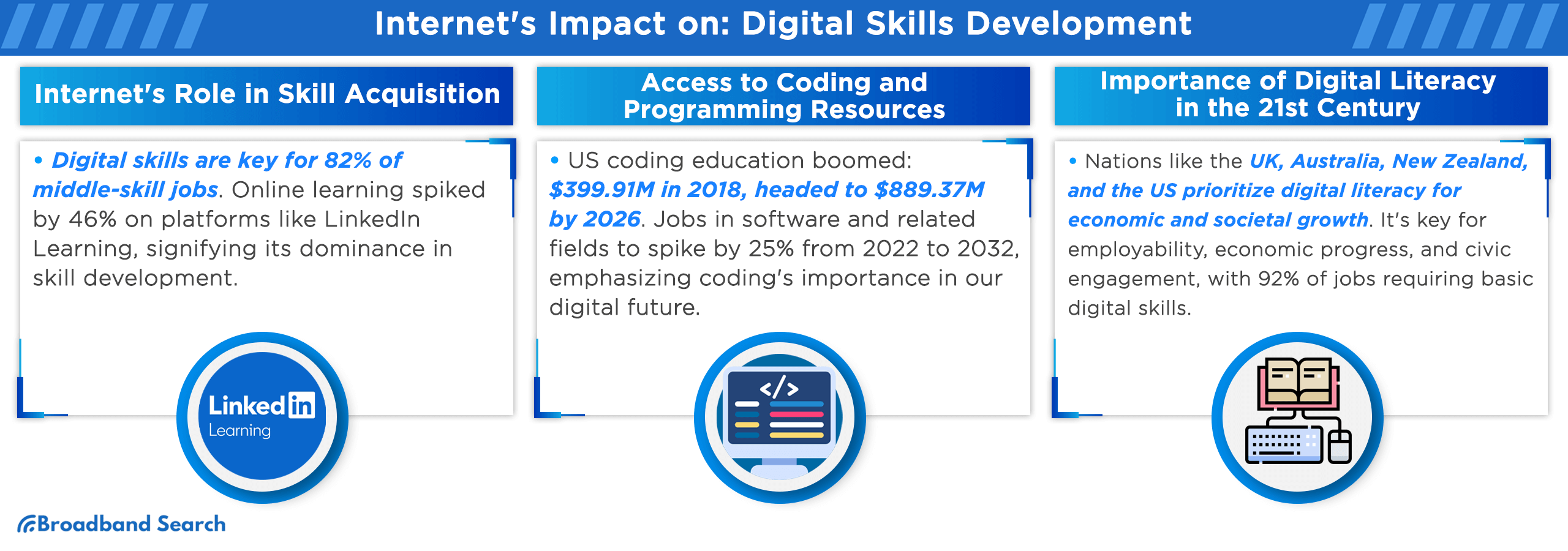
- According to a 2023 National Skills Coalition (NSC) report, 92% of all jobs now require digital skills.
- A notable 68% of current online students were working while studying.
- Online communities like those on Reddit, YouTube, and GitHub make collaborative learning easily accessible.
- An estimated 68% of the world's population (5.5 billion people) is online.
- Approximately 2.6 billion people worldwide remain offline.
How widespread is internet access around the world?
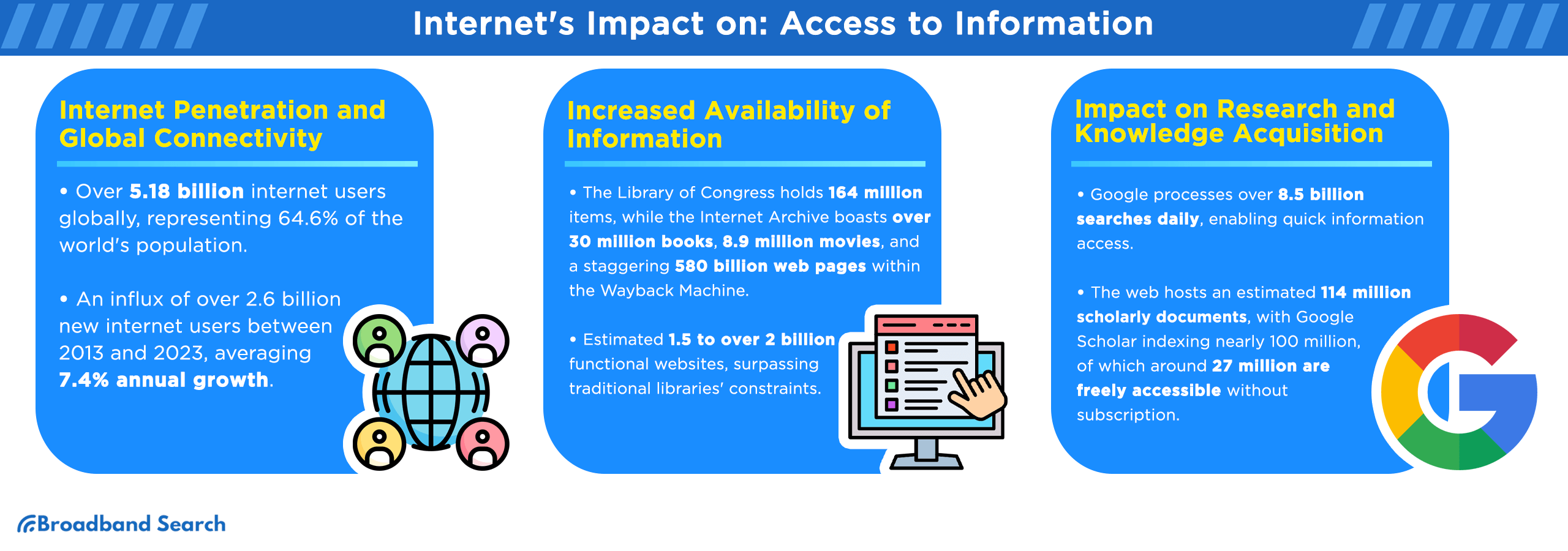
Nearly two-thirds of the world's population — 5.18 billion users — have access to the internet. The rapid growth in internet penetration occurred between 2013 and 2023, with over 2.6 billion people gaining access, which shows an annual growth rate of 7.4%.
We've seen an increase in the scale of information storage as the digital age has evolved. Some digital archives contain billions of items, far exceeding the capacity of traditional physical libraries. A great example is the Library of Congress, which holds 164 million items, compared to the Internet Archive, which has over 560 billion web pages and billions of other digital media files.
Internet storage remains seemingly endless, with an estimated number of functional websites between 1.5 and 2 billion, with around 252,000 added each day.
When Did Online Learning Become Available?
Online education began with early distance-learning methods, such as through traditional mail and educational broadcasts.
With the arrival of computers, the first completely online courses emerged in the 1980s. The University of Phoenix developed the first fully online degrees in 1989. Jones International University became the first accredited, fully web-based institution in 1996.
The COVID-19 pandemic dramatically accelerated this growth. In 2020, school closures forced an abrupt shift to remote learning for 1.2 billion children globally. This resulted in the percentage of U.S. higher education students using distance learning more than doubling from 36.9% in 2019 to 74% in 2020, fundamentally changing education.
How did the internet change higher learning?
The internet fundamentally changed higher education by making education accessible anytime, anywhere, removing barriers to distance and physical location.
The internet enabled the creation of online degree programs and free global resources such as MOOCs (Massive Open Online Courses), shifting learning from rigid classrooms to flexible digital platforms.
How many people have taken online courses?
It is estimated that 3.5 million people enrolled in 2024 across 3,438 institutions, with around 73.8 million people globally learning online..
In 2023, 53.2% of all postsecondary students in the United States took at least one distance education course. A separate report states 10.1 million college students (54%) took at least one online class in 2022. Globally, the number of online learning users is projected to rise to 57 million by 2027.
What are the top reasons why people opt to take online classes?
Online courses inherently have flexibility and convenience because they can be taken anywhere. But as the internet continues to change, so does the ability to customize your entire college experience online.
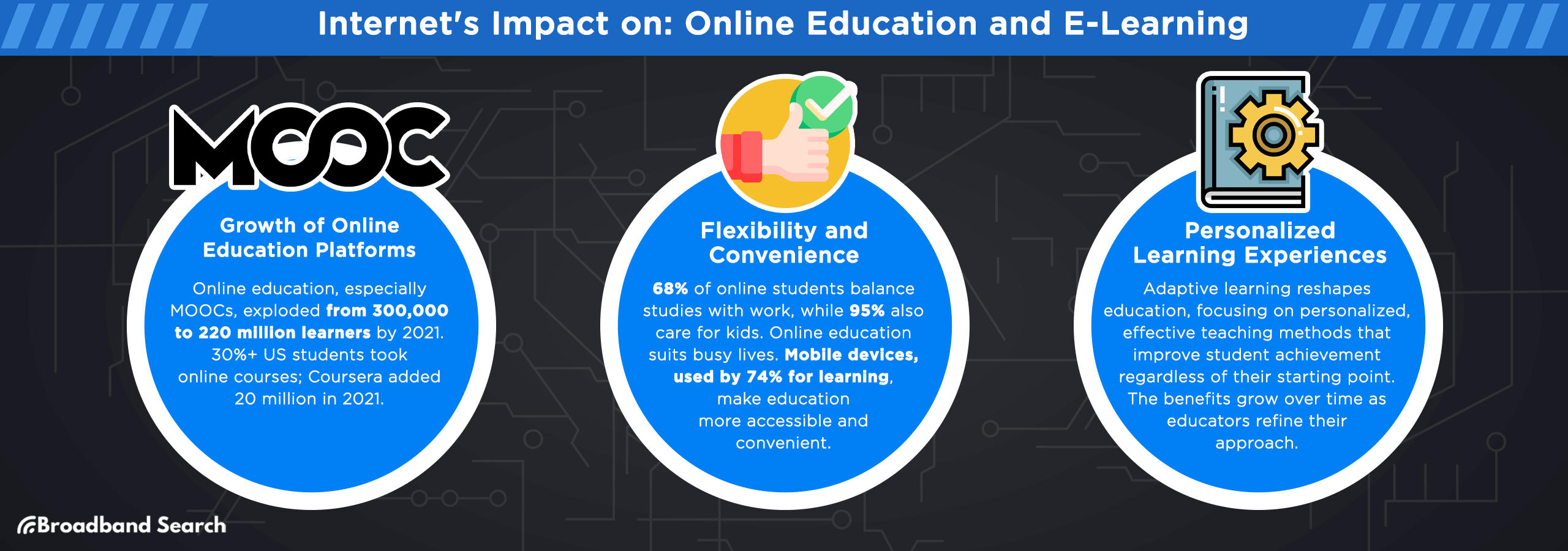
Flexibility. One survey shows that 68% of current online students were working either full-time or part-time. On top of that, 95% of them also care for children under 18, making attending traditional college classes next to impossible.
- Convenient. Research shows that the shift is significant, with one study finding that 74% of learners now use mobile devices for online classes.
- Customization. AI is adding another layer of convenience to accessing higher education. It uses student data to customize curricula, moving away from a one-size-fits-all teaching model.
What is the role of the internet in acquiring digital skills?
The internet plays an essential role in acquiring digital skills by serving as a vast, accessible, and flexible educational platform. \
The internet provides immediate, global access to a wealth of resources, including online courses, tutorials, educational videos, and digital libraries, allowing individuals to learn at their own pace and from anywhere in the world.
Demand for digital skills. A 2023 report from the National Skills Coalition (NSC) found that 92% of jobs now require digital skills.
Rise of access to easy education. Online tutorials and courses have become the main way people learn new skills. Data shows that online learning is widely used to gain new knowledge and improve skills.
What is the role of online communities in collaborative learning?
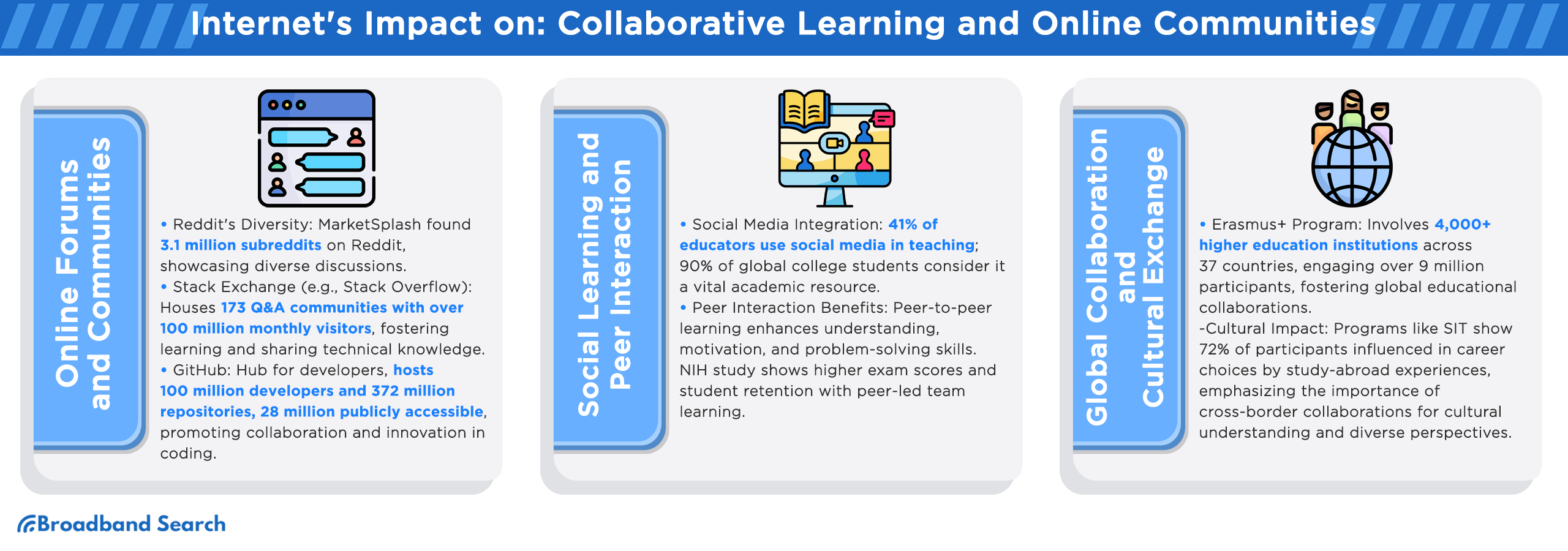
Boards and forums have hosted online discourse since the beginning of the internet. Reddit is a perfect example of a forum-like social news site where people around the world with shared interests can gather to discuss their favorite fandoms or raise awareness of causes.
YouTube functions as a prominent platform for informal online learning communities. While it is primarily a video-hosting site, its features enable collaborative learning in several ways. It allows for content creation and feedback, discussion and Q&A, and access to experts from around the world.
Schools for International Training (SIT) is an accredited global program that specializes in immersive, field-based cross-cultural education. Students move beyond traditional classrooms, engaging in hands-on learning through homestays with local families, site visits, and community interaction.
GitHub is another important platform for software developers to collaborate and innovate. More than 100 million developers use the service to store, manage, and share knowledge.
Does social media have a role in online learning?
Statistics show that 41% of teachers now incorporate it into their classrooms, while a whopping 90% of college students use it as an academic resource.
Peer-to-peer learning helps students better understand, stay motivated, and improve their problem-solving skills. One study by the National Institutes of Health (NIH) found that peer interaction online improved test scores and higher student retention rates.
How does global collaboration improved and expanded access to online education?
Cross-border projects that promote the exchange of knowledge have given global citizens greater access to online programs.
One standout is the Erasmus+ program. It has been increasingly successful in promoting international education. With over 4,000 higher education institutions across 37 countries and more than 9 million participants since its start, it is cultivating cross-cultural information exchange.
What are the challenges and concerns with online learning?
- Online learning has many advantages, but it also introduces significant challenges, including equity, information integrity, and cognitive load.
- The digital divide. As of 2024, an estimated 68% of the world's population (5.5 billion people) is online. This means approximately 2.6 billion people worldwide remain offline, accounting for nearly one-third of the global population.
- Information overload. A 2021 NIH study found that children as young as eight were exposed to an average of 4.5 hours of media per day. The same survey cited 12-year-olds averaged over 8 hours per day. For each additional year of age, an individual consumes nearly an extra hour of media a day.
- Misinformation. Misinformation is a prevalent issue online, even in classrooms. According to a Stanford University study, 82% of middle school students couldn't distinguish between a credible news article and a sponsored piece of content. Institutions are fighting misinformation and ensuring quality control through fact-checking websites like Snopes and PolitiFact.
- AI in learning. Significant concerns about AI in online education include the potential for reduced critical thinking skills, data privacy and algorithmic bias, the "digital divide" in access, and the loss of the essential human element in teaching and learning.
FAQ
Are online courses as effective as traditional ones?
Online courses can be as effective as traditional ones. Still, their success hinges on several factors, including the course's design, the learner's level of engagement, and their ability to manage their own learning.
How can educators combat misinformation in online education?
By teaching students to analyze, evaluate, and create media, educators can develop the critical thinking skills needed to identify credible information and combat misinformation.
Can I earn a degree entirely online, and will employers recognize it?
You can earn an online degree, and employers will accept them in most cases, especially from accredited, reputable institutions.
What are some recommended online resources for digital literacy and online learning?
Numerous resources are available, including MOOC platforms like Coursera and edX. You can also find courses on LinkedIn Learning and digital literacy tutorials from organizations such as Mozilla and Common Sense Media.
Does online learning allow students to progress at their own pace?
Many online courses are self-paced, allowing students to learn at their own speed.
How can online institutions and educators embrace AI for online teaching and learning?
Online institutions and educators can embrace AI by using it to personalize learning experiences, automate administrative tasks, create dynamic content, and provide new forms of support. By integrating AI, educators can personalize lessons, use AI tutors for student support, automate grading and other busywork, and create more engaging content and assessments.
How can educators manage students' use of AI in coursework and deliverables?
Educators can manage student AI use by first establishing clear, transparent policies on the syllabus regarding what is and isn't allowed, and then by designing assignments that either incorporate AI as a tool or require critical thinking beyond simple AI generation.
How has the internet changed education?
The internet has transformed education by providing unprecedented access to information, enabling flexible and personalized online learning, and creating opportunities for global collaboration.